 Just across the Washington-Idaho border from where I live right now is Kootenai County. What a cool name for a county! According to the NYTimes interactive map, Idaho Democrats (all 10,000 of them) voted overwhelmingly for Barack Obama. Unfortunately for him, it does not look so peachy keen for him in California. Clinton is cleaning house there.
Tuesday, February 05, 2008
Kootenai County Comes Through
Just across the Washington-Idaho border from where I live right now is Kootenai County. What a cool name for a county! According to the NYTimes interactive map, Idaho Democrats (all 10,000 of them) voted overwhelmingly for Barack Obama. Unfortunately for him, it does not look so peachy keen for him in California. Clinton is cleaning house there.


Mitt Catches Montana
Looks like Mitt Romney is doing well in the West. He got Montana.
 I highly recommend floating the wild and scenic upper Missouri River on a canoe if you ever have a chance. It is largely as Lewis and Clark saw it 200 years ago. Email me if you want some tips or suggestions about this gem of a trip.
 I highly recommend floating the wild and scenic upper Missouri River on a canoe if you ever have a chance. It is largely as Lewis and Clark saw it 200 years ago. Email me if you want some tips or suggestions about this gem of a trip.
Connect A Cut
Obama takes a squeaker and McCain continues his northeastern state sweep (minus Massachusetts, of course). An alternative spring break trip took me to Bridgeport, Connecticut in college. We stayed in a church that had duckpin bowling in the basement. That was awesome. During the day, I worked demolition along-side some ex-prisoners living in halfway houses. I learned a lot about prison rehab. It was the beginning of my eyes opening to much that is broken with the criminal justice system - especially applied to inner city Black men.
Battleground For Evolution
It seems like the kind of people that fight creationism in Kansas (probably Democrats) also prefer Obama over Clinton. In truth, Obama's victory probably has more to do with the KS governor's endorsement of him and his mother's family ties to the state than anything else. Oh, and only 25,000 people showed up to caucus. I wonder if there was some cold weather there or something... Or maybe that's as many Democrats as live in the state.

This topographical map clearlyshows that Kansas is not flat. I believe this is your best bet for amber waves of grain, too... Or is that Nebraska? South Dakota? Hmmm...
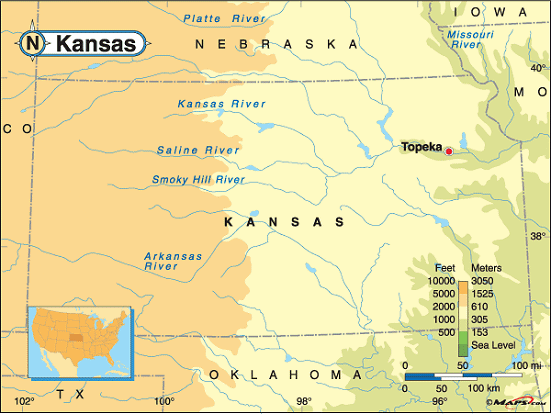
This topographical map clearlyshows that Kansas is not flat. I believe this is your best bet for amber waves of grain, too... Or is that Nebraska? South Dakota? Hmmm...
You Betcha, Obama!

Thanks no doubt to the work put forth by Tangled Up in Blue Guy at his caucus, Obama has taken the Land of 10,000 Lakes. Looks like Romney's got the red part of the state, which is surprising to me given Minnesota's tendency to elect independents. If you have been to this particular lake, you should immediately recognize its significance. A couple of posts ago, I mentioned I drove through North Dakota en route to Seattle. This is why.
Not Much There
 By 'there,' I mean in my memory. I don't mean to speak badly about Alabama. There's a good medical school there and that's where space camp is. As a matter of fact, the only memory I have from Alabama is at the U.S. Space and Rocket Center. My family stopped there on the way to Disney World one year. Obama won Alabama, and Huckabee seems to have the upper hand on the other side.
Bison bison
 Obama won North Dakota! I drove through North Dakota when I moved to Seattle! My PhD advisor is from North Dakota! The latin name for buffalo is Bison bison! That's redundant!
The Other Thanksgiving
 Before I ended up in college in Pennsylvania, if my family traveled for Turkey Day, it was to St. Louis to visit my Dad's mom and sisters. Favorite November activities included the St. Louis Science Center and playing Rummikub. I traveled back to MO for a med school interview and for the 2006 AAAS meeting. Both times I was privileged to be able to hang out with my aunt and uncle again. What was the point of this post? Oh yeah - it looks like Clinton's got it for the Dems. The Reps are in a three-way heat, however.
 Update 9:15 PST: Obama has pulled ahead by a hair in MO.
Thanksgiving
 Thanksgiving get-togethers at Bridgewater, NJ. Several cousins with careers in the sciences. Psychiatry. Metallurgy. Medicine. Bioengineering. Conversations about politics that the older (more political diverse) generation avoided... Advice about medical school. Delicious turkey.
Clinton and McCain nab the Garden State according to everyone except the NYTimes.
Going to Mass
They're not Catholic, but Clinton and Romney collected the offering that state had to offer.
This live blogging business is hard. Must stay focused. Maybe I'll try a checklist.
My time in Massachusetts: Staying in the Boston youth hostel to visit my sister at Northeastern.
 Science in Massachusetts: Ripping my pants at the Whitehead Institute when I toured MIT as a prospective undergraduate.
Hmmm... I'll strike the checklist. How many states do I have left? 15!!!?!?!?!!! Yikes!
This live blogging business is hard. Must stay focused. Maybe I'll try a checklist.
My time in Massachusetts: Staying in the Boston youth hostel to visit my sister at Northeastern.
 Science in Massachusetts: Ripping my pants at the Whitehead Institute when I toured MIT as a prospective undergraduate.
Hmmm... I'll strike the checklist. How many states do I have left? 15!!!?!?!?!!! Yikes!
Delaware
 Delaware = Obama according to CNN
I built castles of sand at Rehoboth.
Now I'm an engineer. Kindof.
Arkansas
The former first lady has AR on the blue side, and the former governor won on the red. The two were never married, however. That would be interesting, wouldn't it. When I was in high school, I went on a church mission trip to Benton, Arkansas where we did home repair a la Habitat for Humanity.  On our day off, we all went river canoeing. When one canoe wedged between the current and a rock, I helped free it. In the process, I smashed a finger. For that, I got a splint and some Tylenol-3. Arkansas ERs look similar to those elsewhere. When I grow up, I might be an ER doctor. I probably will not work in Arkansas, however.
 On our day off, we all went river canoeing. When one canoe wedged between the current and a rock, I helped free it. In the process, I smashed a finger. For that, I got a splint and some Tylenol-3. Arkansas ERs look similar to those elsewhere. When I grow up, I might be an ER doctor. I probably will not work in Arkansas, however.
New York!
 I got engaged in New York City. It was an elaborate scavenger hunt featuring lions and bears and an awesome sister who took an overnight Greyhound trip from Boston to help stage it. Anyway, the papers seem to think Clinton one this one. She'd be in trouble if she didn't.
New Years' Eve
 Southern Miss routed my alma mater in the 1997 Liberty Bowl in Memphis, TN. Three friends from Pitt and I took a winter Midwest road trip to Memphis for the big game. (All Pitt students got free tickets - we just had to show up.) My adventure went from Libertyville, IL to Gary, IN to Newton, IL to Memphis, TN. Pitt lost 7-41. The consolation was seeing Rufus Thomas sing "Walkin' the Dog" on the streets of Memphis. What's the science connection here? One of my friends went on to be the science education director at Pittsburgh's Carnegie Science Center.
Oh Yeah, Fox seems to think Clinton won TN.
Ill: A Noise
 I lived in Illinois from 4th grade to high school. Suburban Chicago, of course. I was one of the kids in my group of friends who was allowed to drive into the city whenever I wanted. Well, almost. So I spent a good deal of my high school free time doing stuff down there. Highlights (in retrospect, of course) include taking advantage of my parents' memberships at the Field Museum and Art Institute. I saw a coelacanth (preserved) in a behind the scenes tour once. Lots of formative years as a scientist in Illinois, too. Thank you Abbott Laboratories and Libertyville High School.
Of course, this one went to Obama. I wonder what the margin will be.
Are You OK?
Somebody says that Clinton's got Oklahoma. I'm not so sure. OK is the only state in the union I haven't set foot in. According to my father, with whom I am in a 50 state competition, riding a train through the panhandle doesn't count. As far as I know, Oklahoma is the flattest state. The Earth, however is not flat. But some people used to think it was.
GA was Peachy
 The best thing to come out of Georgia for me was a chance encounter with a kindred soul. I was interviewing for the MD/PhD program at Emory & Georgia Tech and met Lee; there for the same reason. We just clicked. Since then, we have probably spent a total of 8 days together. My top three schools were the UW, Emory and UCSD. He preferred UCSD, Emory and the UW. So we ended up on the left coast but in different corners. I saw him when I was in La Jolla for a conference and happened to be at another conference in Michigan the weekend he got married there. Well anyway, it looks like Obama won.
WIld & Wonderful
 So the WV GOP goes to Huckabee... If ou're down with GOP, you're down with Huckabee...
My most fond memory from West Virginia is a backpacking trip in the Otter Creek Wilderness with Peter Cheeze and my friend Damion. It rained the whole time. We jumped into streams to clean off the mud. The sky always seemed to brighten, only to pour harder. The trip ended with several hours at a business called Leisure Laundry in back woods WV. Later in that trip, we saw Damion's brother perform in a State Park production of The Hatfields & McCoys. Fun Times!
Image from CNN.
Live Blogging
Since I've decided to skip studying for the political super bowl tonight, I'm going to try my hand at live blogging. Since the major outlets (I'm following NYTimes) have pretty good coverage with political substance, I will provide accounts from each state that range from random to esoteric. (All will be based on my own experiences in each state.)
For those of you who run a feeder with my blog, I am sorry to clog it up today.
For those of you who run a feeder with my blog, I am sorry to clog it up today.
An Election Spoiler
Are you planning on reading political commentary, listening to the news channel talking heads or gathering with your friends to watch the election results roll in tonight? If that's all you'll be doing, you'll be missing out on the analytical powers of prophesy offered by one of the most sought after prognosticators of the primary election in one small region of Spokane, Washington. Specifically, I refer to the interactive science art installation titled:
"These Colors Don't Run (they grow mold, ferment, degrade, are infested with insects, turn to slime and just plain smell bad):
A Long Term Study Of The Forces Of Nature On Assorted Fruits From The Western United States"
Wood, Glass, Found Berries
Thomas Robey
January 8, 2008 - February 5, 2008

A Long Term Study Of The Forces Of Nature On Assorted Fruits From The Western United States"
Wood, Glass, Found Berries
Thomas Robey
January 8, 2008 - February 5, 2008

A longitudinal record of this tool demonstrates its 100% accuracy as a predictor of primary election outcomes - of all parties! But here's a refresher. I started out back on the "First in the Nation" primary on January 8 with an idea that an evolving installation of natural and formed elements could actually tell me who would win the presidential election. To my surprise, by the time Nevada and South Carolina rolled around, the test tubes' predictions corresponded to the outcomes of the race.
But that's all history. Today we face something bigger, something monumental, something so important that I am forced to turn to rotten fruit for guidance.
 Let's start by taking account of the facts. The red rose hips are moldy. They have been consumed with different species. A mild filamentous growth is competing with a blue-green bread mold. That's right, red is being consumed by blue. More on that later. The most striking finding is that the snowberries have been consumed by a monoculture pearly filamentous species. The white rose hips are untouched. The small false grape have developed a dusting of white at the bottom inch or so of that sample. Surprisingly, the blue marbles' plaque-like mold has receded from the two fruits closest to the cork.
Here's what I draw from these findings:
But that's all history. Today we face something bigger, something monumental, something so important that I am forced to turn to rotten fruit for guidance.
 Let's start by taking account of the facts. The red rose hips are moldy. They have been consumed with different species. A mild filamentous growth is competing with a blue-green bread mold. That's right, red is being consumed by blue. More on that later. The most striking finding is that the snowberries have been consumed by a monoculture pearly filamentous species. The white rose hips are untouched. The small false grape have developed a dusting of white at the bottom inch or so of that sample. Surprisingly, the blue marbles' plaque-like mold has receded from the two fruits closest to the cork.
Here's what I draw from these findings:
- The Republicans (red rose hips) are spoiled. While not yet rotten, if one were to venture too close, a foul odor would certainly be detected.
- Red voters are thinking of crossing over to vote for blue candidates (blue mold).
- What once was portrayed as a leader/follower race on the blue side is now more balanced. One candidate has backed off on the degradation, while the other has wavered from the 'fresh' category to something better described as 'stale.'
- Whatever snowberries (third from left) represent is doomed. Maybe the middle road is still treacherous in American politics?
Monday, February 04, 2008
Step 1: Vote. Step 2: ...
Tomorrow's the big day. Everyone expects McCain to get the Republican nomination, while that same 'everyone' seems to think that the Clinton/Obama race will not be decided by this time tomorrow. That means that many more people's votes will 'count' in this primary season than in a long time. (Ever?) If you're undecided about voting, please get out there and pick someone. I am not one to criticize how you select a candidate. If you're not careful, I could get all cliche on you with over-the-top statements like, "You've got the power!" or something.
If you are a scientist who wants to make a difference in Washington, you can do more than vote. You can lobby! The best part is that you can get a travel scholarship to do it. I flew to D.C. last year and met with the staffs from three of my elected officials, as well as several others. The Coalition for Life Sciences sponsors three Hill Days each year. You go to D.C., get trained about how to lobby for science, and then go home enlightened/jaded/cynical about the legislative process. Sound interesting? Check out this information. The Hill Days they have scheduled are March 12, 2008, May 7, 2008 and July 9, 2008. The deadline for applications for March is February 13. By the way, this group used to be call the Joint Steering Committee for Public Policy, but who knew that had anything to do with science? I'm glad they changed their name.
I went last year the weekend after I defended. It was the first time someone (other than my family) addressed me as "Dr. Robey." If you want to read about some of my experiences, I wrote a few posts last fall about my time. Otherwise, drop me an email, and I could answer specific questions you have about it.
And don't forget to check back in tomorrow to see the ultimate in elections predictions. I've been tracking the early returns, and I think there could be a spoiler!
If you are a scientist who wants to make a difference in Washington, you can do more than vote. You can lobby! The best part is that you can get a travel scholarship to do it. I flew to D.C. last year and met with the staffs from three of my elected officials, as well as several others. The Coalition for Life Sciences sponsors three Hill Days each year. You go to D.C., get trained about how to lobby for science, and then go home enlightened/jaded/cynical about the legislative process. Sound interesting? Check out this information. The Hill Days they have scheduled are March 12, 2008, May 7, 2008 and July 9, 2008. The deadline for applications for March is February 13. By the way, this group used to be call the Joint Steering Committee for Public Policy, but who knew that had anything to do with science? I'm glad they changed their name.
I went last year the weekend after I defended. It was the first time someone (other than my family) addressed me as "Dr. Robey." If you want to read about some of my experiences, I wrote a few posts last fall about my time. Otherwise, drop me an email, and I could answer specific questions you have about it.
And don't forget to check back in tomorrow to see the ultimate in elections predictions. I've been tracking the early returns, and I think there could be a spoiler!
Sunday, February 03, 2008
A New Convergence?
Is there room at the center to talk about religion and politics? Jim Wallace of the Sojourners thinks so. He's got a new book describing our country as the post-religious right America. I haven't read it, but Seattle PI's Joel Connelly got me interested enough to put it on my Amazon wish list. I think I'd even subscribe to Sojourners Magazine. If only I had more time to read. I've kinda got a backlog. And there's something else I have to do...
What was it?
Shoot, I'm getting forgetful in my old age.
What was it?
Shoot, I'm getting forgetful in my old age.
Super Bowl Commercial
If you are as un-American as I am, and will not be watching the Super Bowl this afternoon, or if you happen to live in one of the 26 states that will not have elections this week, you may yet be interested in seeing the first commercial ever placed in the Super Bowl by a political candidate*.
I'm sure it varies by market, but that this spot costs about $250,000 dollars in Boston. Now we know where that $32 million raised in January is going. Might it have been cheaper to buy a national spot?
I still haven't decided, but things keep pointing in the direction of Obama for me... I'm going to review the two remaining Dems' positions on health care again before I make a decision.
What am I doing with my time not spent in front of the TV?
Hat tip to The Caucus blog, who by the way, misuses an apostrophe in the second paragraph of the post. It's not like I never misuse punctuation, but doesn't the NYTimes need to be held to a higher standard?
*I'm actually not sure this is true, but it sounds true. Can anyone out there help me fact check?
I'm sure it varies by market, but that this spot costs about $250,000 dollars in Boston. Now we know where that $32 million raised in January is going. Might it have been cheaper to buy a national spot?
I still haven't decided, but things keep pointing in the direction of Obama for me... I'm going to review the two remaining Dems' positions on health care again before I make a decision.
What am I doing with my time not spent in front of the TV?
- During the daylight, I'll be sledding.
- At night, I'll be working on manuscript revisions.
Hat tip to The Caucus blog, who by the way, misuses an apostrophe in the second paragraph of the post. It's not like I never misuse punctuation, but doesn't the NYTimes need to be held to a higher standard?
*I'm actually not sure this is true, but it sounds true. Can anyone out there help me fact check?
Saturday, February 02, 2008
Double Dipping
It's time for the Super Bowl, and you know what that means - you'll be going to a Super Bowl party. The folks over at ScienceBlogs are making a big deal about double dipping - you know, the socially scorned practice of going back into the spinach dip or salsa with a chip that you had already munched. Dr. Free-Ride, Greg Laden, OmniBrain and Tara Smith all have chimed in. Evidently there's a lot of bacteria that gets transferred in the mouth to chip to dip to chip to mouth pathway. 10,000 bacteria. That sounds like a lot. Or is it?
1) How many of those bacteria cause disease?
2) How many of them do you not have in your mouth already?
3) What's the equivalent transfer from multiple hands going into the same snack bag?
Frankly, I'd rather get someone else's mouth bacteria than their hand bacteria. Because you know what hand bacteria is the same as? That's right, folks: butt bacteria. And butt bacteria can cause real problems.
And there's one more thing. If you really want to stay healthy during the Super Bowl, don't bother with safe dipping. In this case, I advocate dip abstinence. What's in those dips? Mayo, cheese, sour cream, butter; this equals fat, fat, fat, salt salt salt. And that's before we consider the chip... Now I don't have any evidence behind this, but my hunch is that this stuff will kill you faster than the bacteria you'll pick up this afternoon.
Just say no to dips and chips. You'll avoid anxiety over bugs, and your waist will thank you.
1) How many of those bacteria cause disease?
2) How many of them do you not have in your mouth already?
3) What's the equivalent transfer from multiple hands going into the same snack bag?
Frankly, I'd rather get someone else's mouth bacteria than their hand bacteria. Because you know what hand bacteria is the same as? That's right, folks: butt bacteria. And butt bacteria can cause real problems.
And there's one more thing. If you really want to stay healthy during the Super Bowl, don't bother with safe dipping. In this case, I advocate dip abstinence. What's in those dips? Mayo, cheese, sour cream, butter; this equals fat, fat, fat, salt salt salt. And that's before we consider the chip... Now I don't have any evidence behind this, but my hunch is that this stuff will kill you faster than the bacteria you'll pick up this afternoon.
Just say no to dips and chips. You'll avoid anxiety over bugs, and your waist will thank you.
Friday, February 01, 2008
Four Of Twelve
I just spent a good 15 minutes leaning back in a La-Z-Boy staring at a popcorn ceiling thinking about precisely nothing. My wife is cuddled up on the faux leather sofa mumbling about blanket transplants.
These are the small joys of being a third year medical student.
It's nice to be home. Kindof. We've transformed this very brown apartment that the University of Washington provides for us into a semblance of home. Cut apart calenders adorn the walls, her orchids contrast with the snow outside, and my art projects sit around screaming out for explanation.
Today was our last day of inpatient call in Spokane, WA. Eight more weeks of medicine to go, but more on that later.
 Today offered nice closure for me. At 1:00 I was invited to do a knee arthrocentesis. (At 12:45, I watched a video about how to do it.) After one unsuccessful poke (not deep enough), the syringe started to fill with a slightly cloudy yellow fluid. I pulled 20 cc out, disconnected the needle and proceeded to extract another 25 cc to reduce the joint space pressure and provide symptomatic relief. We then sent three vials to the lab for cell counts, Gram stains and chemistry.
A successful procedure.
But wait! There's more!
My senior resident had arranged for a rheumatologist to look at the sample. We were thinking septic arthritis (arthritis caused by infection), but had a suspicion that something else was going on. The patient didn't have a fever, both knees hurt and both wrists hurt; this is all a little strange for an infectious cause.
The thing is, the rheumatologist happened to be across town. Guess who filled the role of messenger. I've written about how medical students don't do a lot that is not duplicated. How could I forget about the vital role of urgently transporting samples? I was surprised about how important I felt walking around with a biohazard transport container. (Thinking in my head the irony of the statement, "Get this to rheumatology, STAT!")
When I found the office where the sample was to be read, it turns out that the doc was really busy and someone had totally botched up his microscope. He was having a dandy of a time getting the sample in focus. Isn't it convenient that I spent four years in a pathology research lab hunched over scopes? When I had finished preparing the wet mount, I called him over to look at something like this:
 I've said it before, and while it may come off as a little pretentious, I kindof like the sound of:
What's your diagnosis, doctor?
After leaving the scope much better than I found it, I headed back to the hospital, where we promptly started dexamethasone therapy and discontinued the vancomycin he was on (His ears had started to ring).
My adventures concluded by visiting the patient to update him about what we found and how we changed his medicines. I left his room at 3:45.
This is medicine: suspicion, diagnostic procedure, microscopic laboratory examination, diagnosis, therapy decision. Hopefully the result is a patient free of pain and home for the Super Bowl.
You better believe I'll think twice before telling someone "I'm waiting for a lab result" again.
This patient agreed to my writing about him on the internet. ("After all, it's not like you're sticking me with a big needle," he said.) Also, my wife attests to the accuracy of my portrayal of our evening .
These are the small joys of being a third year medical student.
It's nice to be home. Kindof. We've transformed this very brown apartment that the University of Washington provides for us into a semblance of home. Cut apart calenders adorn the walls, her orchids contrast with the snow outside, and my art projects sit around screaming out for explanation.
Today was our last day of inpatient call in Spokane, WA. Eight more weeks of medicine to go, but more on that later.
 Today offered nice closure for me. At 1:00 I was invited to do a knee arthrocentesis. (At 12:45, I watched a video about how to do it.) After one unsuccessful poke (not deep enough), the syringe started to fill with a slightly cloudy yellow fluid. I pulled 20 cc out, disconnected the needle and proceeded to extract another 25 cc to reduce the joint space pressure and provide symptomatic relief. We then sent three vials to the lab for cell counts, Gram stains and chemistry.
A successful procedure.
But wait! There's more!
My senior resident had arranged for a rheumatologist to look at the sample. We were thinking septic arthritis (arthritis caused by infection), but had a suspicion that something else was going on. The patient didn't have a fever, both knees hurt and both wrists hurt; this is all a little strange for an infectious cause.
The thing is, the rheumatologist happened to be across town. Guess who filled the role of messenger. I've written about how medical students don't do a lot that is not duplicated. How could I forget about the vital role of urgently transporting samples? I was surprised about how important I felt walking around with a biohazard transport container. (Thinking in my head the irony of the statement, "Get this to rheumatology, STAT!")
When I found the office where the sample was to be read, it turns out that the doc was really busy and someone had totally botched up his microscope. He was having a dandy of a time getting the sample in focus. Isn't it convenient that I spent four years in a pathology research lab hunched over scopes? When I had finished preparing the wet mount, I called him over to look at something like this:
 I've said it before, and while it may come off as a little pretentious, I kindof like the sound of:
What's your diagnosis, doctor?
After leaving the scope much better than I found it, I headed back to the hospital, where we promptly started dexamethasone therapy and discontinued the vancomycin he was on (His ears had started to ring).
My adventures concluded by visiting the patient to update him about what we found and how we changed his medicines. I left his room at 3:45.
This is medicine: suspicion, diagnostic procedure, microscopic laboratory examination, diagnosis, therapy decision. Hopefully the result is a patient free of pain and home for the Super Bowl.
You better believe I'll think twice before telling someone "I'm waiting for a lab result" again.
This patient agreed to my writing about him on the internet. ("After all, it's not like you're sticking me with a big needle," he said.) Also, my wife attests to the accuracy of my portrayal of our evening .
Thursday, January 31, 2008
Contact Information
You're reading this post because you like the way I write or are interested in employing me as a freelance writer. If you have an idea for a collaboration or project that you think I am the write person for, I am happy to hear about it.
I am interested in various forms of compensation, including:
Thanks for reading!
I am interested in various forms of compensation, including:
- a book in exchange for a review,
- authorship in a circulated journal or magazine,
- collaboration resulting in a peer-reviewed publication,
- monetary compensation
- the opportunity to think deeply about an interesting topic and
- point-counterpoint articles with other bloggers.
Thanks for reading!
Only A Medical Student
About the only thing a medical student doesn't duplicate on the hospital care team is time spent with patients. With their time, students contribute to care in a manner others cannot.
A thorough exam to assure nothing is overlooked. Tucking in the developmentally delayed adult with her stuffed animal. Listening to a hero's WWII stories.
This is the medicine no drug company will ever invent. It is the treatment Medicare will never reimburse.
Is this year the only period of my life when I dispense the prescription of time?
A thorough exam to assure nothing is overlooked. Tucking in the developmentally delayed adult with her stuffed animal. Listening to a hero's WWII stories.
This is the medicine no drug company will ever invent. It is the treatment Medicare will never reimburse.
Is this year the only period of my life when I dispense the prescription of time?
Tuesday, January 29, 2008
Dear Reviewer,
Dear Reviewer,
It's only been a few weeks since we last wrote, and we've been talking on and off for a little while now, but I feel like I hardly know you. The space between us is so vast, sometimes I wonder whether our inter-continental attempts to communicate are lost. Your cut and paste letters arrive in my mailbox, dog-eared from forwarding and labeled with a baffling cipher. Even so, seeing the message awaiting my expectant eyes causes my heart to skip a beat. You surprise me every time - always waiting until I've almost forgotten about you to postmark your note. This roller coaster can't be healthy can it? I want to get on the page, reviewer. Help me to be on the same page as you.
When it comes down to it, you and I share a love. You know who I speak of. Beauty and Truth are her nicknames. Maybe you've had a few spats with her, too. For me, every time we make up and move on, she becomes more important to my life. I know I am just one small tool in her quest, but us together, my friend? We empower her! Without yours and my relationship, dear reviewer, she has no legs, no foundation. Her name means to split, to cleave; she is knowledge.
I don't mean to tell you how to be in this relationship. After all, I am many years your junior. Still in the cradle, really. And you! Where to begin? You have everything that I aspire to. The big house, the sweet toys, dutiful admirers... But think about when you were in my shoes. You know: with your name out in front. What was it that you needed from your young flings?
Do you feel the connection between us? You've already taught me a thing or two about life. But I have to admit: I want more out of our relationship. I'm going to make this easy for you. I want you to understand me in little chunks, so I am going to use that mainstay of my generation: the bulleted list.

Sincerely,
The Author
It's only been a few weeks since we last wrote, and we've been talking on and off for a little while now, but I feel like I hardly know you. The space between us is so vast, sometimes I wonder whether our inter-continental attempts to communicate are lost. Your cut and paste letters arrive in my mailbox, dog-eared from forwarding and labeled with a baffling cipher. Even so, seeing the message awaiting my expectant eyes causes my heart to skip a beat. You surprise me every time - always waiting until I've almost forgotten about you to postmark your note. This roller coaster can't be healthy can it? I want to get on the page, reviewer. Help me to be on the same page as you.
When it comes down to it, you and I share a love. You know who I speak of. Beauty and Truth are her nicknames. Maybe you've had a few spats with her, too. For me, every time we make up and move on, she becomes more important to my life. I know I am just one small tool in her quest, but us together, my friend? We empower her! Without yours and my relationship, dear reviewer, she has no legs, no foundation. Her name means to split, to cleave; she is knowledge.
I don't mean to tell you how to be in this relationship. After all, I am many years your junior. Still in the cradle, really. And you! Where to begin? You have everything that I aspire to. The big house, the sweet toys, dutiful admirers... But think about when you were in my shoes. You know: with your name out in front. What was it that you needed from your young flings?
Do you feel the connection between us? You've already taught me a thing or two about life. But I have to admit: I want more out of our relationship. I'm going to make this easy for you. I want you to understand me in little chunks, so I am going to use that mainstay of my generation: the bulleted list.
- You would really help me out if you could write to me in paragraphs. Heck, I'd even take numbered lists. But a single long paragraph makes it hard for me to see you amidst the debris. It's like you don't have time for me or something.
- I've spent many sleepless nights of internal debate musing meaning, tense and commas; I get dressed up for you (but don't use too much makeup, just how you like); I even show you some of my vulnerabilities - the least you could do is use a spell checker. It would make what you write so much sweeter.
- You talk about yourself too much. Sometimes it's like you didn't even listen to me! I know that J. Doe et al did groundbreaking work. That's why I referenced two of their papers. You want another one referenced? I can do that for you. That's how much you mean to me.
- I sit at home reading every word of your letters. Take for example the time you said I looked like I was stained with weak grape juice. That really hurt. But I got through it. Acting on the wisdom of your comment, I actually made a discovery. (See figure below. Click to enlarge.) I never did hear what you thought about it. Am I to take this as an answer? Maybe we should both put this behind us.

- Why do you have to be so schizophrenic? First you love me. Then you hate me. Then you think you might go to a movie with me, but just as friends. What gives?
Sincerely,
The Author
Monday, January 28, 2008
Floating An Idea
In between some pages for patients, I just finished watching snippets of Bush's SOTU and the Democratic response.
One of the calls was for a patient who developed severe tachycardia (his heart rate shot to 150-170) just as Bush began his speech. He assured me that it was not anxiety that caused the spike.
But I digress. If you are planning to vote for a Democrat in the fall, I need your advice. What do you think about the strategy of getting behind your candidate, but not so much that you are upset if she/he doesn't get the nomination? Or is this just a rationalization for me to justify not picking a horse in this race?
One of the calls was for a patient who developed severe tachycardia (his heart rate shot to 150-170) just as Bush began his speech. He assured me that it was not anxiety that caused the spike.
But I digress. If you are planning to vote for a Democrat in the fall, I need your advice. What do you think about the strategy of getting behind your candidate, but not so much that you are upset if she/he doesn't get the nomination? Or is this just a rationalization for me to justify not picking a horse in this race?
Sunday, January 27, 2008
Science Then And Now
Have any of you encountered the creationist tracks extolling the Bible as a scientific text? In one I was recently referred to, evangelist Ray Comfort presents a perspective of science then and now to show just how well our knowledge today was predicted by the Bible. If you promise to read them all, I’ll offer some ideas about Biblical science. Keep in mind that my personal perspective is as a Christian and a scientist who sees very little in conflict with those positions.
At the foundation of each of these claims is that science is not merely about predictions. Science combines innovation and idea with a rugged process of hypothesis testing and repeated fine-tuning to formulate a theory that when applied to unknown situations can explain them to the best of our ability. Unlike Ben Stein’s perception of science as a static entity unchanged since the days of Charles Darwin, elements of science are always in flux.
Right – my points:
1. The SCIENCE NOW/ SCIENCE THEN dichotomy is flawed most simply because the world view in the ancient world was not scientific. Sure there were glimmers of it all over the ancient world – Egypt, Greece, South America, India, China, Arabia – but the progression of thinking of something, testing it objectively and using the results to formulate predictions just hadn’t come around yet. Humans were stuck describing, categorizing and guessing. (This, by the way, worked pretty well for us most of the time.) It is as unfair to claim the then prevailing world-views as science then as it is to claim astrology as science today. Each has made predictions about the world, but only science as we know it today can be tested. (Also recall that ‘science’ wasn’t even a commonly used word until the early 19th Century!)
2. The Bible is not scientific. If it were, the writers would have incorporated those flawed (SCIENCE THEN) explanations into its stories. The world would not have been created in six days; it would have been vomited by a scarab. I admit, this second point is not as strong. It actually makes me sound like I’m in a “Yes it is/No it’s not” argument. Even so, I don’t think I have written enough recently of my opinion that the Bible is not a scientific text. The absence of there even being science when it was written aside (see point 1, above), few in Christendom or the Jewish or Muslim worlds would identify these texts as scientific. What else was there to describe in these verses but items in the natural world? Referring to rocks does not make your novel a geologic text. Even the references cited in the list above are oblique references to physical phenomena. Check out the Job 38:19-20 text. I’m pretty used to sorting out metaphors in the Bible; maybe that’s why identifying these verses as referring to the propagation of light was so hard. By the way, in this section of his trials, God is speaking to Job in the midst of a terrible storm. It is often interpreted as emphasizing the power of God and the finite knowledge of man, both in the ways of the world and the ways of Heaven.
These are my raw thoughts on this matter. If I didn’t have to study up on anemia and GI disease tonight (how appropriate!), maybe I could formulate some more succinct arguments. I guess I will have to leave some of that up to you, dear reader.
Big hat tip to Tangled up in Blue Guy.
1. THE BIBLE: The earth is a sphere (Isaiah 40:22). SCIENCE NOW: The earth is a sphere. SCIENCE THEN: The earth was a flat disk.This list is a clever attempt by certain Creationists to claim the Bible as scientific. This doubtless is a rhetorical tactic in the effort to confer legitimacy to the Genesis accounts of creation. There are two main problems with this presentation: 1) Science did not exist until the sixteenth century and 2) The Bible is not a scientific text.
2. THE BIBLE: Incalculable number of stars (Jeremiah 33:22). SCIENCE NOW: Incalculable number of stars. SCIENCE THEN: Only 1,100 stars.
3. THE BIBLE: Free float of earth in space (Job 26:7). SCIENCE NOW: Free float of earth in space. SCIENCE THEN: Earth sat on a large animal.
4. THE BIBLE: Creation made of invisible elements (Hebrews 11:3). SCIENCE NOW: Creation made of invisible elements (atoms). SCIENCE THEN: Science was mostly ignorant on the subject.
5. THE BIBLE: Each star is different (1 Corinthians 15:41). SCIENCE NOW: Each star is different. SCIENCE THEN: All stars were the same.
6. THE BIBLE: Light moves (Job 38:19,20). SCIENCE NOW: Light moves. SCIENCE THEN: Light was fixed in place.
7. THE BIBLE: Air has weight (Job 28:25). SCIENCE NOW: Air has weight. SCIENCE THEN: Air was weightless.
8. THE BIBLE: Winds blow in cyclones (Ecclesiastes 1:6). SCIENCE NOW: Winds blow in cyclones. SCIENCE THEN: Winds blew straight.
9. THE BIBLE: Blood is the source of life and health (Leviticus 17:11). SCIENCE NOW: Blood is the source of life and health. SCIENCE THEN: Sick people must be bled.
10. THE BIBLE: Ocean floor contains deep valleys and mountains (2 Samuel 22:16; Jonah 2:6). SCIENCE NOW: Ocean floor contains deep valleys and mountains. SCIENCE THEN: The ocean floor was flat.
11. THE BIBLE: Ocean contains springs (Job 38:16). SCIENCE NOW: Ocean contains springs. SCIENCE THEN: Ocean fed only by rivers and rain.
12. THE BIBLE: When dealing with disease, hands should be washed under running water (Leviticus 15:13). SCIENCE NOW: When dealing with disease, hands should be washed under running water. SCIENCE THEN: Hands washed in still water.
At the foundation of each of these claims is that science is not merely about predictions. Science combines innovation and idea with a rugged process of hypothesis testing and repeated fine-tuning to formulate a theory that when applied to unknown situations can explain them to the best of our ability. Unlike Ben Stein’s perception of science as a static entity unchanged since the days of Charles Darwin, elements of science are always in flux.
Right – my points:
1. The SCIENCE NOW/ SCIENCE THEN dichotomy is flawed most simply because the world view in the ancient world was not scientific. Sure there were glimmers of it all over the ancient world – Egypt, Greece, South America, India, China, Arabia – but the progression of thinking of something, testing it objectively and using the results to formulate predictions just hadn’t come around yet. Humans were stuck describing, categorizing and guessing. (This, by the way, worked pretty well for us most of the time.) It is as unfair to claim the then prevailing world-views as science then as it is to claim astrology as science today. Each has made predictions about the world, but only science as we know it today can be tested. (Also recall that ‘science’ wasn’t even a commonly used word until the early 19th Century!)
2. The Bible is not scientific. If it were, the writers would have incorporated those flawed (SCIENCE THEN) explanations into its stories. The world would not have been created in six days; it would have been vomited by a scarab. I admit, this second point is not as strong. It actually makes me sound like I’m in a “Yes it is/No it’s not” argument. Even so, I don’t think I have written enough recently of my opinion that the Bible is not a scientific text. The absence of there even being science when it was written aside (see point 1, above), few in Christendom or the Jewish or Muslim worlds would identify these texts as scientific. What else was there to describe in these verses but items in the natural world? Referring to rocks does not make your novel a geologic text. Even the references cited in the list above are oblique references to physical phenomena. Check out the Job 38:19-20 text. I’m pretty used to sorting out metaphors in the Bible; maybe that’s why identifying these verses as referring to the propagation of light was so hard. By the way, in this section of his trials, God is speaking to Job in the midst of a terrible storm. It is often interpreted as emphasizing the power of God and the finite knowledge of man, both in the ways of the world and the ways of Heaven.
These are my raw thoughts on this matter. If I didn’t have to study up on anemia and GI disease tonight (how appropriate!), maybe I could formulate some more succinct arguments. I guess I will have to leave some of that up to you, dear reader.
Big hat tip to Tangled up in Blue Guy.
Saturday, January 26, 2008
Blogging Codes of Ethics
Over the last year, I have grown into the moniker of "blogger." There are many out there who still speak disparagingly of blogs and bloggers. (They are likely not reading this post!) But now that major media outlets all have their own blogs, it is less clear to me that blogging is a fringe activity. In the past month, I have started to think more critically about the blogger's roles of furthering knowledge, sparking conversation and providing venues for personal growth. This was first apparent to me when I started posting about patient encounters. Patient privacy and the law each have something to say about disclosing information related to patients, and bloggers must respect both. That is why I subscribe to the Healthcare Blogger Code of Ethics. Starting today, you will see a new logo in my sidebar referring to that decision.
As blogging becomes more prevalent, and as certain bloggers achieve more prominence, I think it is important for us to address the responsibilities we have as writers and interpretors. My blog is not strictly a science blog; lately it has taken more of a healthcare blog. There are also plenty of entries that hit a little closer to home than some of my readers care for. In the end, in all of my posts, I strive to balance interesting with informative.
I'm still not sure of the precise relationship between blogger and journalist. One of my friends from high school is successful at both. Perhaps more than personal blogging, science and health bloggers are journalists. The blogger's roles as informer are dependent on the same principle as science: truthfulness. The interpretation part of blogging is where truthiness becomes more prominent. Opinions and interpretation occur more in blogs than in the newspaper (aside from the op-ed page), and it is certainly not difficult to see the differences between discussion sections of scientific papers and the lengthy diatribes we bloggers occasionally partake in. Keep in mind that these two are only points along the same spectrum.
Is there a code of conduct that can be constructed for science bloggers? In response to discussions organized by Dr. Free-Ride at the 2008 Science Blogging Conference, she has built a Science Blogging Ethics Wiki where ideas for a code of conduct (including whether there needs to be one) can be bounced around. Three of the main sections of the code that have emerged so far include:
 I started posting about patient encounters. Patient privacy and the law each have something to say about disclosing information related to patients, and bloggers must respect both. That is why I subscribe to the Healthcare Blogger Code of Ethics. Starting today, you will see a new logo in my sidebar referring to that decision.
As blogging becomes more prevalent, and as certain bloggers achieve more prominence, I think it is important for us to address the responsibilities we have as writers and interpretors. My blog is not strictly a science blog; lately it has taken more of a healthcare blog. There are also plenty of entries that hit a little closer to home than some of my readers care for. In the end, in all of my posts, I strive to balance interesting with informative.
I'm still not sure of the precise relationship between blogger and journalist. One of my friends from high school is successful at both. Perhaps more than personal blogging, science and health bloggers are journalists. The blogger's roles as informer are dependent on the same principle as science: truthfulness. The interpretation part of blogging is where truthiness becomes more prominent. Opinions and interpretation occur more in blogs than in the newspaper (aside from the op-ed page), and it is certainly not difficult to see the differences between discussion sections of scientific papers and the lengthy diatribes we bloggers occasionally partake in. Keep in mind that these two are only points along the same spectrum.
Is there a code of conduct that can be constructed for science bloggers? In response to discussions organized by Dr. Free-Ride at the 2008 Science Blogging Conference, she has built a Science Blogging Ethics Wiki where ideas for a code of conduct (including whether there needs to be one) can be bounced around. Three of the main sections of the code that have emerged so far include:
- Responsibilities to readers
- Responsibilities to other bloggers
- Responsibilities to sources
Thoughts On Third Year
Another of my articles is up over at The Differential.
 Click here to read my take on the unique tension between being on the hospital care team, but not yet as a physician.
Click here to read my take on the unique tension between being on the hospital care team, but not yet as a physician.
Physician, Heal Thyself
As I was losing half a gallon of fluids out of my gut tube last night, I couldn't get a certain phrase out of my mind: "Physician, heal thyself." Unfortunately for me, the only healing available for acute gastrointestinal illness is time. After passing from the acute phase of my illness into the achey recovery, the earliest reference I could find to this maxim was:
Generally, this phrase is understood as a rhetorical metaphor referring to the expectancy of folks in Jesus' hometown for him to work miracles there like he had elsewhere.
For it to be used metaphorically, the chances are good that "heal thyself" was around well before it was documented in the Bible. I am guessing it originated in those cradles of Western medicine: Egypt or Greece.
This is, by the way, the first time I have vomited in my adult life. Before last night, I never understood why patients weren't able to fully describe the color and consistency of their vomit. Now I know! The first thing on your mind after the purge (besides old proverbs, of course) is "get rid of it!"
And he said unto them, Ye will surely say unto me this proverb, Physician, heal thyself: whatsoever we have heard done in Capernaum, do also here in thy country.
Luke 4:23
Generally, this phrase is understood as a rhetorical metaphor referring to the expectancy of folks in Jesus' hometown for him to work miracles there like he had elsewhere.
For it to be used metaphorically, the chances are good that "heal thyself" was around well before it was documented in the Bible. I am guessing it originated in those cradles of Western medicine: Egypt or Greece.
This is, by the way, the first time I have vomited in my adult life. Before last night, I never understood why patients weren't able to fully describe the color and consistency of their vomit. Now I know! The first thing on your mind after the purge (besides old proverbs, of course) is "get rid of it!"
Thursday, January 24, 2008
Student Work Hours
If you don't want to read another complaint from another medical student, stop reading now.
You've probably heard somewhere along the line that medical residents are limited to 80 hours a week and no more than 30 hour shifts.
Medical students often have the privelege of working more than that. Remember that we are not covered by any work hours restriction.
I am in the 3rd week of my inpatient medicine clerkship. Here is my 'required' schedule:
Monday 6:30 AM to Tuesday 1:15 PM = 30.75 hrs
Wednesday 6:30 AM to 6:00 PM = 11.75 hrs
Thursday 6:30 AM to Friday 1:15 PM = 30.75 hrs
Saturday 6:30 AM to Noon = 5.5 hrs
What am I complaining about? Our total hours adds up to 78.75 - plenty of room before the 80 hour limit, right? Subtract out the 3 or 4 hours I get when I am on overnight, and that puts me at 71.5 hours. What am I complaining about?
You've probably heard somewhere along the line that medical residents are limited to 80 hours a week and no more than 30 hour shifts.
Medical students often have the privelege of working more than that. Remember that we are not covered by any work hours restriction.
I am in the 3rd week of my inpatient medicine clerkship. Here is my 'required' schedule:
Monday 6:30 AM to Tuesday 1:15 PM = 30.75 hrs
Wednesday 6:30 AM to 6:00 PM = 11.75 hrs
Thursday 6:30 AM to Friday 1:15 PM = 30.75 hrs
Saturday 6:30 AM to Noon = 5.5 hrs
What am I complaining about? Our total hours adds up to 78.75 - plenty of room before the 80 hour limit, right? Subtract out the 3 or 4 hours I get when I am on overnight, and that puts me at 71.5 hours. What am I complaining about?
If I want to have my patient progress notes written in time for rounds, I need to check up on my patients in the morning. Sometimes I'll get in at 6:00 to see a patient so that I'm ready to present my three patients at rounds.
What I don't like is that I need to study, too. That will have to wait. In the end, I'm lucky to be in medical school.
Tuesday, January 22, 2008
Insulated
Whatever goes on in the world, there will still be sick people.
Evidently, the world is on the brink of financial collapse. Somehow, I missed that. While folks from Wall St. to Main St. were freaking out about the economy, I was talking with a patient who had been largely unconscious since last Thursday. This is a Gram stain of a sample of that patient's cerebral spinal fluid:
 What's your diagnosis, doctor?
I also understand that yesterday was a holiday. Of all the national holidays, Martin Luther King Jr. Day has always been the one with the most regimented for me. Sometimes I would fast on that day, I would always read some of King's writings, often I would participate in a community service project; yesterday I took call. The only nod to the holiday I experienced were some residents questioning whether it was actually a holiday, and a newspaper article about how (unlike 800 other cities) Spokane has no geographical reference to Martin Luther King Jr.
Evidently, the world is on the brink of financial collapse. Somehow, I missed that. While folks from Wall St. to Main St. were freaking out about the economy, I was talking with a patient who had been largely unconscious since last Thursday. This is a Gram stain of a sample of that patient's cerebral spinal fluid:
 What's your diagnosis, doctor?
I also understand that yesterday was a holiday. Of all the national holidays, Martin Luther King Jr. Day has always been the one with the most regimented for me. Sometimes I would fast on that day, I would always read some of King's writings, often I would participate in a community service project; yesterday I took call. The only nod to the holiday I experienced were some residents questioning whether it was actually a holiday, and a newspaper article about how (unlike 800 other cities) Spokane has no geographical reference to Martin Luther King Jr.
Sunday, January 20, 2008
Married to Medicine
Want a little peek into my personal life? Head over to The Differential for my latest column.
 Here's a snippet:
Here's a snippet: Sure, it’s sometimes hard to guess when to be a colleague and when to be a husband, but then there’s something about being married -– most of the time, you just know.
Saturday, January 19, 2008
SC And NV As Measures Of The Southern Electorate
It looks like Hilary Clinton has won the Nevada Democratic caucuses. Romney took the Republican vote there, and at this time, South Carolina is still up for grabs. Let me try to break down the implications of this for you by consulting my clairvoyant test tube wonder-rack.
 It appears that the blue marbles at right (proper name: Elaeocarpis grandis) have developed a white scaly monospecies growth. The effect is quite striking, a simple, raised white scale with well demarcated borders in 0.5 mm to 8 mm diameter colonies involves the surface of each fruit without altering the underlying azure pigmentation. The next development since New Hampshire is a localized proliferation of filamentous grey mold on select snow berries. Colonization is limited to berries that have undergone chromatic denigration (white to brown). Numerous unaltered berries persist. The other specimens remain grossly intact, but with minor signs of degradation and dehydration.
What does this all mean? I invite you to consider these berries' initial presentation and put forth your own opinion. Rarely is one person's political commentary enough. Since this is my blog, I'll start us off.
My read of the blue marble phenomenon has troublesome implications for the Democratic party. To have such a large contingent of the blue tubes' representation contaminated with mold suggests either that the principles or approach of the party is failing. An alternative interpretation is that one tube (one candidate, perhaps?) is off to a quick start but that the direction is fallible. What about the lack of change in the red tubes? We must consider that the red tubes do represent the conservative party. Conservatives tend to resist change, after all. The small amount of dehydration (indicated by shriveled skin) demonstrates some initial signs of fatigue early in the race. We might expect some of the specimens to endure the race differently. It will be interesting to seewhat happens by the next primary. Super-Duper Test Tubesday appears to be the next contest of note. Check back then for more completely serious analysis.
I hope by this point that you realize my method as no more rotten than the analysis techniques favored by the talking heads on the news networks.
 It appears that the blue marbles at right (proper name: Elaeocarpis grandis) have developed a white scaly monospecies growth. The effect is quite striking, a simple, raised white scale with well demarcated borders in 0.5 mm to 8 mm diameter colonies involves the surface of each fruit without altering the underlying azure pigmentation. The next development since New Hampshire is a localized proliferation of filamentous grey mold on select snow berries. Colonization is limited to berries that have undergone chromatic denigration (white to brown). Numerous unaltered berries persist. The other specimens remain grossly intact, but with minor signs of degradation and dehydration.
 What does this all mean? I invite you to consider these berries' initial presentation and put forth your own opinion. Rarely is one person's political commentary enough. Since this is my blog, I'll start us off.
My read of the blue marble phenomenon has troublesome implications for the Democratic party. To have such a large contingent of the blue tubes' representation contaminated with mold suggests either that the principles or approach of the party is failing. An alternative interpretation is that one tube (one candidate, perhaps?) is off to a quick start but that the direction is fallible. What about the lack of change in the red tubes? We must consider that the red tubes do represent the conservative party. Conservatives tend to resist change, after all. The small amount of dehydration (indicated by shriveled skin) demonstrates some initial signs of fatigue early in the race. We might expect some of the specimens to endure the race differently. It will be interesting to seewhat happens by the next primary. Super-Duper Test Tubesday appears to be the next contest of note. Check back then for more completely serious analysis.
I hope by this point that you realize my method as no more rotten than the analysis techniques favored by the talking heads on the news networks.
Friday, January 18, 2008
Surviving Overnight Call
There are probably numerous anecdotal reports out there about how to survive a post-call afternoon. I am too delirious to do the work of finding and/or categorizing them right now. Anyone have any tips?
For those outside of medicine, post-call is the afternoon after you were up most of the night caring for hospital patients. My two previous rotations only required me to stay at the hospital until midnight. Inpatient medicine is another story. I am at the hospital for 30 hour shifts twice a week.
While I am in the hospital, I'm pretty sure my cognition is around my baseline. I cannot however say that I am used to being post-call yet.
The first time I pushed through the afternoon with caffeine, went to bed early and woke up groggy at 3 AM. The next experiment involved cutting the caffeine at 10 AM (I am on until 1:00), taking a brief nap when I got home, exercising somewhere in there and then going to bed at a normal hour. In those cases, I got 4-5 hours in the hospital sleep room. Last night, I only got 2-3 hours. I promptly crashed for 3 hours when I got home, completed a rather lame attempt at a workout and now am still awake...
I have tried to eat my regular 3 balanced meals, but when you are up for strange hours, I think another meal or snack needs to be thrown into the mix. We must also consider the regularity and balance offered by hospital cafeteria cuisine.
Anyone out there have any tips? You should know that I have a celebrated history (as an undergraduate) of conducting all-nighters without much difficulty or consequence. I haven't decided if my difficulty these days is that I'm 1) out of practice or 2) old.
For those outside of medicine, post-call is the afternoon after you were up most of the night caring for hospital patients. My two previous rotations only required me to stay at the hospital until midnight. Inpatient medicine is another story. I am at the hospital for 30 hour shifts twice a week.
While I am in the hospital, I'm pretty sure my cognition is around my baseline. I cannot however say that I am used to being post-call yet.
The first time I pushed through the afternoon with caffeine, went to bed early and woke up groggy at 3 AM. The next experiment involved cutting the caffeine at 10 AM (I am on until 1:00), taking a brief nap when I got home, exercising somewhere in there and then going to bed at a normal hour. In those cases, I got 4-5 hours in the hospital sleep room. Last night, I only got 2-3 hours. I promptly crashed for 3 hours when I got home, completed a rather lame attempt at a workout and now am still awake...
I have tried to eat my regular 3 balanced meals, but when you are up for strange hours, I think another meal or snack needs to be thrown into the mix. We must also consider the regularity and balance offered by hospital cafeteria cuisine.
Anyone out there have any tips? You should know that I have a celebrated history (as an undergraduate) of conducting all-nighters without much difficulty or consequence. I haven't decided if my difficulty these days is that I'm 1) out of practice or 2) old.
A Case For Obama
Brain. Quivers. Like. Jello. I'm post-call today. Yesterday I admitted one patient to the intensive care unit, and unfortunately, another coded and needed to move down there. Needless to say, I did not have much time for sleeping.
It's times like these that I can rely on my friends to say thoughtful things about stuff. The rest of this post is an email to me from one of my MD/PhD colleagues when I revealed just how undecided I am about the upcoming Democratic primary. He also happens to write a column for Seattle's alternative newspaper The Stranger called Dear Science. Each point has a link to a longer, wittier post over at Slog, The Stranger's blog.
It's times like these that I can rely on my friends to say thoughtful things about stuff. The rest of this post is an email to me from one of my MD/PhD colleagues when I revealed just how undecided I am about the upcoming Democratic primary. He also happens to write a column for Seattle's alternative newspaper The Stranger called Dear Science. Each point has a link to a longer, wittier post over at Slog, The Stranger's blog.
I'm leaning heavily towards Obama, for three disparate reasons.Me too. Oh yeah - that's because it's 17 degrees in Spokane...
1. His favorite TV shows are M.A.S.H. and The Wire. (Ok. I'm being somewhat serious here.) The wire perks my ears up. It's a seriously dark-minded exploration of the decay of US cities and communities. Most intriguingly, a central theme is the limited ability of those in power and institutions to deal with the problems faced. Any president (or presidential candidate) who starts from this attitude gets some respect from me just for self honesty.
2. Obama, when he was a State senator, initially supported a bill to require universal influenza vaccination during the last big shortage. Public health advocates visited him and explained that during a shortage it is way better to limit the vaccine to those who really need it--the infirm and health care workers predominantly. He argued back, asked tough questions, but eventually was convinced. He publicly supported the less politically tractable but empirically "correct" policy, even though it wasn't his initial judgment. To my mind, this demonstrates why Obama the most "scientific" candidate--willing to critique, accept and change with data.
3. His rhetorical strength is well suited to the presidency. Hillary and he essentially support the same policies. Hillary claims she knows how to best maneuver in the existing political environment. Obama claims that he can *change* the political reality to make dramatic policy changes. I find Obama's read to be the more compelling. In other words, Hillary has made and excellent case for herself--as senate majority leader.
Pair up an Obama presidency with a Hillary Clinton led senate? Wow. I get shivers.
Tuesday, January 15, 2008
Metastatic Prostate Cancer
This one is heavy.
Sitting on his bed, without my white coat, without my clipboard, and without a rehearsed statement, I was simply present with him. I still can't find the words to describe my feelings in that moment. Why can I not pin down my emotions? Was it confidence about a puzzle solved? Relief that the patient was finally given an answer? Surprise at how much the patient already knew (even without symptoms or knowledge of lab results)? Was I feeling an adrenaline rush due to an awareness that I was participating in an important point in this man's life?
In the end, the question I need guidance about is: Is it wrong to be comfortable delivering bad news?
This patient gave me permission to write about these experiences but asked me not to use his name.
"You and I talked yesterday about the blood prostate test that came back with a very high value. That combined with your low blood counts is why we did the bone scan this morning. It looks like some prostate cancer has spread to your pelvis and tailbone."It's taken a while for me to work this first experience delivering a cancer diagnosis into a cogent journal entry. When it comes to this blog, I have the most success transcribing ideas and feelings immediately. This one required more drafts; a whole folder of entries spanning several days sits tucked away on my hard drive. What I keep coming back to is that through my entire experience with this patient, I never felt uneasy.
Sitting on his bed, without my white coat, without my clipboard, and without a rehearsed statement, I was simply present with him. I still can't find the words to describe my feelings in that moment. Why can I not pin down my emotions? Was it confidence about a puzzle solved? Relief that the patient was finally given an answer? Surprise at how much the patient already knew (even without symptoms or knowledge of lab results)? Was I feeling an adrenaline rush due to an awareness that I was participating in an important point in this man's life?
In the end, the question I need guidance about is: Is it wrong to be comfortable delivering bad news?
This patient gave me permission to write about these experiences but asked me not to use his name.
Are you SAD?
If you've heard of SAD, you've also heard about light therapy. If you pass off light boxes as voodoo, you've overlooked a body of scientific literature indicating otherwise.
 Head over to The Differential for my latest article about seasonal affective disorder (SAD) in medical school. While you are there, check out the good posts by Ben and Kendra about medical marijuana and successful presentations on the wards. (Those are two different posts.)
Oh - and SharpBrains has the lastest installment of Grand Rounds. The gracious host accepted all 38 entries (so I got in!) and formulated each into a question for the next US President.
Sunday, January 13, 2008
Washington Precinct Caucuses 2008
It is less than four weeks until Washington State begins the process of nominating candidates for president. Unlike many states, Washington has both party caucuses and a primary. If you are a Democrat, the primary doesn't count for anything. It's more complex if you are a Republican. (Washington Republicans pick 49 percent of their delegates at Feb. 9 caucuses, and 51 percent in a Feb. 19 primary. Washington Democrats pick all their delegates at Feb. 9 caucuses.)
Caucusing is a little complex, and this post is meant to remove some of the mystery of it for you. Pay attention, because Washington State could actually make a difference this year. (Especially if what seems to be the Obama-Clinton race is not settled by February 5th's Super-Duper Tuesday.)
My experience with this phenomenon includes caucusing for Howard Dean in 2004; I was a delegate to the 46th Congressional District Convention several weeks after the precinct caucus. By then, Kerry had clinched the nomination, so all of the delegates (even if their initial choice was out) lined up for him. He eventually carried Washington's primary (and later the general election).
Caucuses are a way to bring communities together to argue the merits and demerits of presidential candidates. In Seattle, they mostly occur in churches, schools and libraries. Those in attendance from each precinct gather for a more-or-less structured debate about the candidates. After eye-to-eye conversation (and sometimes conversion), several polls are taken. Any candidate with more than 15% of the vote is then entitled to delegates to the total reported in newspapers the next day. These delegates move on to the district, county and state conventions, with the final outcome of the selection of Washington's delegates to the parties' national nominating conventions. Caucuses and conventions are ways to begin the party mobilization process - essentially organizing get-out-the-vote efforts 9 months before the general election. (Somewhere in there is a really good gestation metaphor.) It's not just the presidential race that is considered, though. Die-hards can offer resolutions at the precinct level that have the opportunity to contribute to district, county and state party platforms. A basic explanation of the Democrats' system is available here.
In the end, what happens February 9 mostly just provides bragging rights for whichever candidates remain in the hunt.
The first tier in the caucus-convention cycle consists of the precinct caucuses which will be held on Saturday, February 9, 2008 at 1:00 pm at a location in or near your neighborhood. Because you have to be present in person to participate, it's important to know your precinct number. In King County, visit this web page to look up that information. That page will tell you your polling place, BUT NOT YOUR CAUCUS SITE! That is because the state runs the primary and the parties run the caucuses. To find your caucus site, you need to go to your state's or county's party website. The best is the caucus finder on the Washington State Democrats' web page. To help my one King County Republican reader find his caucus information, here is the website you will need. Where you caucus really matters which party you are in. For example, if I were a Republican, I'd be heading to the Nathan Hale High School cafeteria. Since I'm a Democrat, I'll be heading to Sand Point Methodist Church.
The only qualifications permitting a vote by proxy are religious observations, military service or disability. If these apply to you, fill out this form. For me to participate, I'll need to drive to Seattle from Spokane. Fortunately, I have other business in the Emerald City, so the trip will be worth it. Furthermore, I have voted in every election since moving to Washington, and I intend to keep it that way!
By the way, if you are looking for a prognostication of the outcome of these 2008 races, look no further than this blog's predictive installation.
Caucusing is a little complex, and this post is meant to remove some of the mystery of it for you. Pay attention, because Washington State could actually make a difference this year. (Especially if what seems to be the Obama-Clinton race is not settled by February 5th's Super-Duper Tuesday.)
My experience with this phenomenon includes caucusing for Howard Dean in 2004; I was a delegate to the 46th Congressional District Convention several weeks after the precinct caucus. By then, Kerry had clinched the nomination, so all of the delegates (even if their initial choice was out) lined up for him. He eventually carried Washington's primary (and later the general election).
Caucuses are a way to bring communities together to argue the merits and demerits of presidential candidates. In Seattle, they mostly occur in churches, schools and libraries. Those in attendance from each precinct gather for a more-or-less structured debate about the candidates. After eye-to-eye conversation (and sometimes conversion), several polls are taken. Any candidate with more than 15% of the vote is then entitled to delegates to the total reported in newspapers the next day. These delegates move on to the district, county and state conventions, with the final outcome of the selection of Washington's delegates to the parties' national nominating conventions. Caucuses and conventions are ways to begin the party mobilization process - essentially organizing get-out-the-vote efforts 9 months before the general election. (Somewhere in there is a really good gestation metaphor.) It's not just the presidential race that is considered, though. Die-hards can offer resolutions at the precinct level that have the opportunity to contribute to district, county and state party platforms. A basic explanation of the Democrats' system is available here.
In the end, what happens February 9 mostly just provides bragging rights for whichever candidates remain in the hunt.
The first tier in the caucus-convention cycle consists of the precinct caucuses which will be held on Saturday, February 9, 2008 at 1:00 pm at a location in or near your neighborhood. Because you have to be present in person to participate, it's important to know your precinct number. In King County, visit this web page to look up that information. That page will tell you your polling place, BUT NOT YOUR CAUCUS SITE! That is because the state runs the primary and the parties run the caucuses. To find your caucus site, you need to go to your state's or county's party website. The best is the caucus finder on the Washington State Democrats' web page. To help my one King County Republican reader find his caucus information, here is the website you will need. Where you caucus really matters which party you are in. For example, if I were a Republican, I'd be heading to the Nathan Hale High School cafeteria. Since I'm a Democrat, I'll be heading to Sand Point Methodist Church.
The only qualifications permitting a vote by proxy are religious observations, military service or disability. If these apply to you, fill out this form. For me to participate, I'll need to drive to Seattle from Spokane. Fortunately, I have other business in the Emerald City, so the trip will be worth it. Furthermore, I have voted in every election since moving to Washington, and I intend to keep it that way!
By the way, if you are looking for a prognostication of the outcome of these 2008 races, look no further than this blog's predictive installation.
Saturday, January 12, 2008
SMFPNIS For Two Days In A Row!
 Science is big news in Spokane! This picture of molecular anthropologist Dr. Brian Kemp made a splash above the fold on the front page of today's Spokesman Review. Using molecular techniques he devised as a graduate student at UC Davis, he has established the age of native peoples in the Western Hemisphere to exceed 15,000 years. Check out the Discover Magazine story, or the original report in the American Journal of Physical Anthropology. The story in Spokane's paper was to feature how prominent Washington State University is becoming on the national research scene. He actually did the work as a post-doc at Vanderbilt. It seems as though he is setting up a new lab at Wazzu.
If Seattle's papers would stop trying to pick apart the University of Washington for animal research policy, human subject trials and medical mistakes and focus on the positives of having a world class university in the backyard, maybe it would be easier to fund higher education in this state.
Wondering about the acronym in this post's title? Go here.
Friday, January 11, 2008
Science Makes Front Page News In Spokane
Someone once pointed out to me that Seattle is the most educated city in the country. This may be true, but when is the last time you saw SCIENCE on the front page of Seattle's major newspaper? You must look to the other side of the state - where cougars live and snow sticks around for weeks... I've already found a way to be proud of my temporary hometown of Spokane.

Not only did SCIENCE make it to the vaulted pages of the Spokesman Review, it came with the hottest accessory for the lab these days: colored safety goggles. Someone should remind Dr. Pink that the pencil she is absent-mindedly about to put in her mouth could be contaminated with liquid C. The photo accompanied an article about the impending showdown about the No Child Left Behind legislation that President Bush wants to carve into stone tablets. All I have to say is, "Hooray SCIENCE!"
I am not kidding: this was 8 inches wide and above the fold on Friday's paper.

Not only did SCIENCE make it to the vaulted pages of the Spokesman Review, it came with the hottest accessory for the lab these days: colored safety goggles. Someone should remind Dr. Pink that the pencil she is absent-mindedly about to put in her mouth could be contaminated with liquid C. The photo accompanied an article about the impending showdown about the No Child Left Behind legislation that President Bush wants to carve into stone tablets. All I have to say is, "Hooray SCIENCE!"
I am not kidding: this was 8 inches wide and above the fold on Friday's paper.
High On The List Of Conversations Not To Have When You're Post Call Is...
...a discussion of the differential diagnosis for elevated liver enzymes.
Let's back up, shall we!
Post call is the day/ medical-legal term/ state of consciousness that occurs after an overnight shift at the hospital. "Call" has varied meanings in different health systems. For medicine residents, it usually means:
Well, tonight was my very first overnight call. My two previous rotations set medical student call as morning sign-out until midnight. Since my current hospital has a call room for medical students, I get to stay all night. I admitted one patient, and then checked up on my other three, one of whom had a new finding of elevated liver enzymes. Which brings us to the original point of this post: It is difficult to access information (even the basic stuff) when you are not used to staying up all night. There are a number of reasons liver enzymes could be elevated. And because I'm a nice guy, I'll tell you what they are.
Let's back up, shall we!
Post call is the day/ medical-legal term/ state of consciousness that occurs after an overnight shift at the hospital. "Call" has varied meanings in different health systems. For medicine residents, it usually means:
- Coming to work at the normal time of 6:00.
- Working all day.
- Taking care of the hospital service patients at night.
- Staying at the hospital overnight to admit new patients.
- Sleeping from 0-4 hours in a special call sleep room.
- Being available to answer pages from the floor or the ER and responding to codes, if needed.
- Presenting the patients (new and old) the next morning to the regular day team.
- Leaving the hospital no later than 30 hours after arriving.
Well, tonight was my very first overnight call. My two previous rotations set medical student call as morning sign-out until midnight. Since my current hospital has a call room for medical students, I get to stay all night. I admitted one patient, and then checked up on my other three, one of whom had a new finding of elevated liver enzymes. Which brings us to the original point of this post: It is difficult to access information (even the basic stuff) when you are not used to staying up all night. There are a number of reasons liver enzymes could be elevated. And because I'm a nice guy, I'll tell you what they are.
- Drug Toxicity
- Acute Viral Hepatitis
- Steatohepatitis (Alcoholic and Non Alcoholic)
- Biliary Obstruction
- Infarcted Liver
- Traumatic Injury
Wednesday, January 09, 2008
Evidence Based Obstetrics
One of the great things about blogs is how a post about one topic can quickly morph into a good discussion about another. I bet early meetings of Ben Franklin's Junto (or later the American Philosophical Society) were similar to what happens when a good discussion gets hijacked by a barely related intriguing idea.
Anyway, Drugmonkey posted an informative update about the current presidential candidates' positions on science. If there is one topic that has been wrongly overlooked by candidates this election season, it is a proper airing of their perceptions about science and health research funding, the role that science should play in public policy decisions and how science education can be improved. Head over to this DM post for a digest of Science magazine's handling of the candidates' positions on science. Within the comments thread, is a sub-discussion about the lack of scientific evidence for the choices obstetricians make during delivery. The specific question that I argue has no scientific answer to is: Do fetal cardiac decelerations necessitate Caesarian section? I admit: the left turn was kind-of my fault,but my appeal to you, dear reader, is to find your way to this thread and chime in about the role of evidence in Western obstetrical care. (Read about the candidates' views, too!)
I have a love-hate relationship with the current emphasis on 'evidence based medicine.' It is certainly indicated, even needed in many cases. Enough of the studies are poorly designed or in conflict of interest, that it is hard to change a policy because some perspective made it through peer review. I suppose I would advocate a slow transition to evidence-based practice. Meta-analysis means more to me as a mode for medical decision making.
But bringing this full circle, what does it say about the role of science in society that one of the areas of life that is perceived of as being influenced the most by science (medicine), is actually not very scientific? If science cannot be practically applied to medicine, or more specifically birth, can it really be applied to policy decisions? It's not like there's any shortage of research material.
Anyway, Drugmonkey posted an informative update about the current presidential candidates' positions on science. If there is one topic that has been wrongly overlooked by candidates this election season, it is a proper airing of their perceptions about science and health research funding, the role that science should play in public policy decisions and how science education can be improved. Head over to this DM post for a digest of Science magazine's handling of the candidates' positions on science. Within the comments thread, is a sub-discussion about the lack of scientific evidence for the choices obstetricians make during delivery. The specific question that I argue has no scientific answer to is: Do fetal cardiac decelerations necessitate Caesarian section? I admit: the left turn was kind-of my fault,but my appeal to you, dear reader, is to find your way to this thread and chime in about the role of evidence in Western obstetrical care. (Read about the candidates' views, too!)
I have a love-hate relationship with the current emphasis on 'evidence based medicine.' It is certainly indicated, even needed in many cases. Enough of the studies are poorly designed or in conflict of interest, that it is hard to change a policy because some perspective made it through peer review. I suppose I would advocate a slow transition to evidence-based practice. Meta-analysis means more to me as a mode for medical decision making.
But bringing this full circle, what does it say about the role of science in society that one of the areas of life that is perceived of as being influenced the most by science (medicine), is actually not very scientific? If science cannot be practically applied to medicine, or more specifically birth, can it really be applied to policy decisions? It's not like there's any shortage of research material.
Impersonating an MD
Here's an important quiz for you:
Which of the women below is a doctor? Which is a medical student?

 Try not to pay attention to the body language in making your decision... If you're stumped, consult this introductory review.
Sometimes I wonder how much of medicine is just show. Good luck not being stopped by a nurse between the stairwell and the patient's room if your wearing just a shirt and tie. (Actually, I prefer an evidence based wardrobe: tie free and proud.) The appearance of physicianship causes people to hold doors for you, gives you wide berth in the cafeteria, and leads toward more held elevators than I care to list. I almost feel bad making those passengers wait for me as I turn in to the stairwell.
Get to the point, Robey!
Today I left the key to my hospital locker at home. This forced me to make a temporary wardrobe change. Not many med students serve at this hospital, and few of the staff are as large as me. There is a rack of clean guest coats in the residents' locker room; I was lucky to snag one labeled 2XLT. So until the program assistant was able to lend me an extra key, I wore the mantle of a resident. Not only did this coat fit better, it looked good. (Please apply your best girlfriend language to that last phrase.) If you think medical students' white coats look funny down to the hips, consider what it would look like down to the belt. Yes, it is that bad.
Anyway, by 8:00, the administrator had returned so I was able to slip back into my short white cloak of vulnerability. I'll just have to savor my 2 hours of power.
Here's what I will not savor:
Which of the women below is a doctor? Which is a medical student?

 Try not to pay attention to the body language in making your decision... If you're stumped, consult this introductory review.
Sometimes I wonder how much of medicine is just show. Good luck not being stopped by a nurse between the stairwell and the patient's room if your wearing just a shirt and tie. (Actually, I prefer an evidence based wardrobe: tie free and proud.) The appearance of physicianship causes people to hold doors for you, gives you wide berth in the cafeteria, and leads toward more held elevators than I care to list. I almost feel bad making those passengers wait for me as I turn in to the stairwell.
Get to the point, Robey!
Today I left the key to my hospital locker at home. This forced me to make a temporary wardrobe change. Not many med students serve at this hospital, and few of the staff are as large as me. There is a rack of clean guest coats in the residents' locker room; I was lucky to snag one labeled 2XLT. So until the program assistant was able to lend me an extra key, I wore the mantle of a resident. Not only did this coat fit better, it looked good. (Please apply your best girlfriend language to that last phrase.) If you think medical students' white coats look funny down to the hips, consider what it would look like down to the belt. Yes, it is that bad.
Anyway, by 8:00, the administrator had returned so I was able to slip back into my short white cloak of vulnerability. I'll just have to savor my 2 hours of power.
Here's what I will not savor:
- Wearing white coats on the bus. Talk about a power trip. Come on people, get over it already. Yes you are a doctor. You are also one of us. (Speaking as a non-doctor.)
- Wearing coats in the cafeteria. Who knows what other substances rhyming with cafeteria are on that coat. It's worse than Mr. Yuk - It's Dr. Yuk.
- Brown sleeve cuffs and clear signs of dirt. How does the jingle go? A-L-L: the stain lifter!
- White coats at noon conference. At least take the jacket off while you munch on your sandwich.
- Doctors coming out of bathrooms with white coats on. Gross!
Tuesday, January 08, 2008
First in the Nation
What this primary season needs is more science built into the decision making process. To satisfy all of the political empiricists out there, I have adapted my art installation test tube series for the conduction of a long-running experiment. This piece is meant to gage the reactions of the electorate. I-a-want to measure the extent to which politics can be evaluated in the test tube. After all, it seems as though the activation energy has reached a critical mass, especially for the newer reagents on the scene. Let's face it, there are a few catalysts out there fomenting for fermentation. Some of us are already degrading the drawn out run times for this current cycle of American politics. Red or blue, there are many who seek a phase change. More than a sampling would offer that anything could yield relief from the current entropic change we find ourselves in today. What I have for you is:
Yes, Yes, I know - Three different rose hips! I would invite you to find red and white berries in Spokane. In the dark. Beneath several inches of snow. After working in a hospital for 12 hours... What I lack in diversity of species, I hope I make up for in geographic diversity.
Check back for periodic updates on the developments of this piece. Frankly, my expectations are about the same as for the current primary races: decay and destruction with the hope that something great comes of the mess.
Props to DrugMonkey for planting the seed for this experiment.
"These Colors Don't Run (they grow mold, ferment, degrade, are infested with insects, turn to slime and just plain smell bad):
A Long Term Study Of The Forces Of Nature On Assorted Fruits From The Western United States"
Wood, Glass, Found Berries
Thomas Robey
January 8, 2008
A Long Term Study Of The Forces Of Nature On Assorted Fruits From The Western United States"
Wood, Glass, Found Berries
Thomas Robey
January 8, 2008

For those of you keeping track, this is the third version of this living installation. (First & Second) In keeping with the tradition of scientific classification, from left to right we have:
Wild Rose Hips (large, shriveled by frost): Spokane, WA
Wild Rose Hips (small, firm): Spokane, WA
Snowberry: Seattle, WA
Wild Rose Hips (medium, blanched white): Spokane, WA
Wild Grape: Lafayette, CA
Blue Marble Tree Fruit: Honolulu, HI
Wild Rose Hips (large, shriveled by frost): Spokane, WA
Wild Rose Hips (small, firm): Spokane, WA
Snowberry: Seattle, WA
Wild Rose Hips (medium, blanched white): Spokane, WA
Wild Grape: Lafayette, CA
Blue Marble Tree Fruit: Honolulu, HI
Yes, Yes, I know - Three different rose hips! I would invite you to find red and white berries in Spokane. In the dark. Beneath several inches of snow. After working in a hospital for 12 hours... What I lack in diversity of species, I hope I make up for in geographic diversity.
Check back for periodic updates on the developments of this piece. Frankly, my expectations are about the same as for the current primary races: decay and destruction with the hope that something great comes of the mess.
Props to DrugMonkey for planting the seed for this experiment.
Monday, January 07, 2008
Too Legit To Quit?
How long can a newly minted PhD last without having a first author paper to his name?
Evidently, about 3 months...
This is the lead article in the first issue of the 2008 volume of Cardiovascular Pathology. Who says you can't publish negative results? If you recall, there was a bit of a splash earlier this decade about a funny mouse that could (amazingly!) regenerate its heart after injury. To catch up about how this over-hyped story has played out in the last 7 years, read this nice review.
It took a year for this to go to press after it was accepted, hence the lag between earning the PhD and being published. There are more on the way, hopefully including a pair I polished up for submission last Friday. But none will receive the fanfare I afforded this one. There is just something special about the first time.
As far as the post's title, what's up with PhD students slaving in the lab for years and then deciding not to pursue a career in academic science after all? I don't know. Check back with me in a couple of years.
Evidently, about 3 months...
Robey TE, Murry CE. Absence of regeneration in the MRL/MpJ mouse heart following infarction or cryoinjury. Cardiovasc Pathol. 2008;17:6– 13.The text is available with subscription here. Email me or post a comment if you would like a .pdf.
This is the lead article in the first issue of the 2008 volume of Cardiovascular Pathology. Who says you can't publish negative results? If you recall, there was a bit of a splash earlier this decade about a funny mouse that could (amazingly!) regenerate its heart after injury. To catch up about how this over-hyped story has played out in the last 7 years, read this nice review.
It took a year for this to go to press after it was accepted, hence the lag between earning the PhD and being published. There are more on the way, hopefully including a pair I polished up for submission last Friday. But none will receive the fanfare I afforded this one. There is just something special about the first time.
As far as the post's title, what's up with PhD students slaving in the lab for years and then deciding not to pursue a career in academic science after all? I don't know. Check back with me in a couple of years.
The Differential
And now for something completely different(ial):
I now have the privilege of posting weekly over at The Differential. I'll continue to write here at Hope for Pandora, but The Differential affords me a new audience, new colleagues and a venue to more formally explore my experiences and ideas concerning medicine, health policy and graduate medical education. You are welcome to read (and comment on) my entries over there, but if you are a med student, prospective medic or just interested in what the real-life 'Scrubs' is like, I encourage you to read my colleagues' daily posts.
I'll be sure to link each of my articles here whenever they are posted. Here is my introduction. I'll use one of these logos to alert you to a new post:

 By the way, The Differential is part of MedScape, which is itself a branch of WebMD. I'll see you there.
I now have the privilege of posting weekly over at The Differential. I'll continue to write here at Hope for Pandora, but The Differential affords me a new audience, new colleagues and a venue to more formally explore my experiences and ideas concerning medicine, health policy and graduate medical education. You are welcome to read (and comment on) my entries over there, but if you are a med student, prospective medic or just interested in what the real-life 'Scrubs' is like, I encourage you to read my colleagues' daily posts.
I'll be sure to link each of my articles here whenever they are posted. Here is my introduction. I'll use one of these logos to alert you to a new post:

 By the way, The Differential is part of MedScape, which is itself a branch of WebMD. I'll see you there.
Sunday, January 06, 2008
Darwin Trounces HIV
 This just in: Charles Darwin has won the 2007 Spring Science Showdown. For those unclear of this event, it is a parallel (yet protracted) version of college basketball's March Madness. 65 themes, subjects, ideas and personalities from all corners of science converge for a grand battle of wit. Each match-up consists of a science blogger's play-by-play (sort of) commentary on the relative merits of the two entities facing off. The final match was between Darwin and HIV, and in a curious twist was decided by readers' comments. As you can see from this post, Darwin won. Some interesting past match-ups featured internal medicine (my current clerkship), Thomas Kuhn, invertebrates and fossil fuels.
I hope that I can be part of Spring Science Showdown in 2008. With my real-life basketball team (Pitt) missing two of its starters to injuries, I think I am going to need some more abstract objects to root for. As for credentials, I offer this commentary.
Thursday, January 03, 2008
Looking Forward by Reflecting Back
Dr. Free-Ride alerted me to a year-end tradition of referencing a sample of 12 posts from the previous year. Drugmonkey did it, too. Since it's already the new year, this will be a reflective exercise for me - and since I'm late as usual for these sorts of things, I've mixed it up to include the first sentence of the last post in each month. If you click on the month's name, you can read the whole entry (and those from the preceding of the month). Here's to blogging 2007!
Carry on...
- January: Consider this entry the second in a series of accounts detailing the peril of trusting journalists to relay scientific findings to the public.
- February: What? Another bogus study?
- March: Those of you out there who have published scientific papers, have you ever seen this?
- April: Is not driving to work going to affect my carbon footprint?
- May: Have you seen a large, difficult to describe hominid wandering the shores of Puget Sound recently?
- June: It's a Saturday night - June's final day.
- July: Lately, my walks to and from bus stops or around campus have included a little foraging for berries, flowers, coyote scat and other cool stuff.
- August: Evidently, today is BlogDay.
- September: The game is tied in the bottom of the 10th.
- October: A good cartoon tells it the best sometimes.
- November: This is the third part in a series of posts describing a recent visit to two of northern Kentucky's attractions: the Creation Museum and the Ordovician fossil beds.
- December: So continues documentation of my eclectic vacation...
Carry on...
10 Days Past Christmas...
- The days are getting longer (hopefully diminishing SAD).
- A forest of pine trees have commenced a slow march to the curb (hopefully to be composted).
- Wrapping paper has been purged from living rooms (hopefully to be recycled).
- Gifts have migrated from piles into their new homes (hopefully to be used).
- And Christmas is in decay (hopefully to be bleached).
 As a reminder, the original colors were:
Snowberry, Laurel, Hawthorn, Salal Blossom, Fir Twig, Sumac Berry
But more specifically, Christmas is moldy...
 Happy New Year.
Stay tuned for "Experimental Elections". Or perhaps I'll call it "Electoral Reactions." Or "A Test Tube Electorate." Or...
Subscribe to:
Posts (Atom)


