 I've not embedded the clip because YouTube has restricted it and because if you are visiting my front page, you still get to hear the "Imperial March" in the background. Wondering why? Read this. Then watch Susan Boyle live a dream.
Showing posts with label science funding. Show all posts
Showing posts with label science funding. Show all posts
Thursday, April 16, 2009
Dream a Dream
Evidently, television coverage of the "Tea Party" on tax day was pre-empted by another story. Since I've given up using the television for acquiring my news in any form other than presented on Comedy Central or in live broadcasts (debates, live speeches, CSPAN and the lot), I didn't catch this other story until it was echoed in the morning newspapers. Yesterday, a 47-year-old Scot performed a rendition of "I Dreamed a Dream" from "Les Miserables" on the UK's equivalent of American Idol and brought down the house. Much rubbish was made of her frumpy appearance, older age and romantic status in advance of (and after) the performance. Which reminds me that our current day conception of talent is inectricably linked to looks and social status. I'm glad that the show (titled "Britain's got Talent") actually brought out the talent it advertises. Especially if it drowned out some of the shouting about the illogical Tea Party. I actually enjoyed sending in my check this year. But then again I like the idea of the government funding science, cleaning the air, caring for the poor sick and lame, building roads and even defending freedom. I think the rich conservative broadcasters who orchestrated this Tea Party are celebrating a la David Horsey...
 I've not embedded the clip because YouTube has restricted it and because if you are visiting my front page, you still get to hear the "Imperial March" in the background. Wondering why? Read this. Then watch Susan Boyle live a dream.
I've not embedded the clip because YouTube has restricted it and because if you are visiting my front page, you still get to hear the "Imperial March" in the background. Wondering why? Read this. Then watch Susan Boyle live a dream.


Sunday, January 25, 2009
Its Rightful Place
Some pundits have commented that President Obama's inaugural address lacked the catch phrase or memorable line that JFK or FDR offered us in "Ask not what your country can do for you, ask what you can do for your country" or "We have nothing to fear but fear itself."
Perhaps this is true, but what I remember is:
Of course the inaugural address has the potential to be all talk. In his weekly address, he indicated that he will triple the number of fellowships in science. Initially, I wondered if this was at the graduate student, post-doctoral fellow or some other level. But then I found a report on whitehouse.gov with more details about the recovery plan.
With regard to the science in its rightful place goal, it looks like one step is
Moving on, I think we should talk about the inaugural promise to wield technology's wonders to raise health care's quality and lower its cost. How exactly will we wield the wonders? According to the same Recovery Metrics document, the US government hopes to
I recently finished interviewing at 12 emergency medicine residency programs. As part of this, I toured some of the country's busiest emergency rooms; in many places I donned scrubs and saw how things worked 'on the inside.' Many places do have an electronic medical record (EMR), but some hospitals said that they probably wouldn't have a system in place by the time I finished residency (that's in four years). So that's a first strike against this goal. If the emergency departments - who provide primary care for more than 50 million Americans and are the first access point for unscheduled medical problems for everyone else - don't have an EMR, how will everyone's record be computerized?
This problem aside, there are additional barriers that need to be overcome if a 5 year goal is to be achieved.
I applaud both of these goals of training more scientists and making health care safer, but want some more details, too.
Perhaps this is true, but what I remember is:
We will restore science to its rightful place, and wield technology's wonders to raise health care's quality and lower its cost.Let's focus on that first part:
We will restore science to its rightful place.Does that mean the science adviser's office will be moving back into the West Wing???
Of course the inaugural address has the potential to be all talk. In his weekly address, he indicated that he will triple the number of fellowships in science. Initially, I wondered if this was at the graduate student, post-doctoral fellow or some other level. But then I found a report on whitehouse.gov with more details about the recovery plan.
With regard to the science in its rightful place goal, it looks like one step is
tripling the number of undergraduate and graduate fellowships in science, to help spur the next generation of home grown scientific innovation.I wonder where all of those students will go after they have their science degrees? Will industry support them? Because I'm pretty sure academia won't. What about those young scientists who are finding it difficult to get their first grants?
Moving on, I think we should talk about the inaugural promise to wield technology's wonders to raise health care's quality and lower its cost. How exactly will we wield the wonders? According to the same Recovery Metrics document, the US government hopes to
computerize every American’s health record in five years, reducing medical errors and saving billions of dollars in health care costs.Riiiiiggght... This one needs a little talking about.
I recently finished interviewing at 12 emergency medicine residency programs. As part of this, I toured some of the country's busiest emergency rooms; in many places I donned scrubs and saw how things worked 'on the inside.' Many places do have an electronic medical record (EMR), but some hospitals said that they probably wouldn't have a system in place by the time I finished residency (that's in four years). So that's a first strike against this goal. If the emergency departments - who provide primary care for more than 50 million Americans and are the first access point for unscheduled medical problems for everyone else - don't have an EMR, how will everyone's record be computerized?
This problem aside, there are additional barriers that need to be overcome if a 5 year goal is to be achieved.
- A standard computer laguage that all EMR platforms use, so when patients move from one office to another or from one system to another, their info can be brought up in the same interface. As it stands now, this is not even standardized in the same hospital. In many places the emergency room's EMR is different from and cannot communicate with the hospital's!
- For patient safety to be increased, more time and/or staff needs to be allowed for computer entry. In emergency rooms with medical records, I was amazed by the amount of time residents and attendings spend in front of computer monitors instead of with patients. In place of noting information on a clipboard while talking with patients, doctors have an extra hugely time-intensive step of data entry. Technology needs to improve. What about notebook style touch screen terminals? Except that would increase cost...
- Is computerized care better? This seems to be a moot question, because everyone's headed in the digital direction. I'm probably just not well enough read on this topic, as the VA health system and large HMOs like Kaiser are all computerized. Are improvements to care there because of computers, or because everything's in the same system?
I applaud both of these goals of training more scientists and making health care safer, but want some more details, too.
Tuesday, April 01, 2008
No Foolin': NIH to Cater to Young Scientists
Given this notice of a structural overhaul at the NIH, perhaps I should rethink my decision to pass on setting up a basic science lab in favor of the lucrative opportunities available to young scientists. With the champions of scientific humanities bowing to external pressures, I may need to discard my dreams of a career spanning the two cultures...
Saturday, September 29, 2007
Stem Cells in WA: Got Private $?
Saturday's Seattle Post-Intelligencer ran a great article featuring the role of private money in stem cell research in Seattle. The internet version of the story features a nice picture of the Three Amigos of the Seattle stem cell scene.  Randy Moon, Chuck Murry and Tony Blau have traveled the state to raise awareness and money for their Institute for Stem Cells and Regenerative Medicine. That's right, the acronym is pronounced, "Ice Cream!" But seriously, these professors have testified before state legislators in Olympia, schmoozed local philanthropists, given tours of their labs, and enlisted their graduate students to do appropriate outreach. As campaigners for ISCRM, they also are delegates for science. For that, they get a tip of the hat from me. (Speaking of hats, I resisted the urge to enhance the above image with sombreros.)
Their efforts have not been in vain. Several large donations have come in so far, including from Orin Smith (Starbucks), Jeff and Susan Brotman (Costco), and Scott and Laurie Oki (Microsoft). And it's not just the private donations... the UW secured a highly competitive $10 million stem cell grant from the NIH earlier this year. By the way, the UW rents its South Lake Union digs from Paul Allen (Microsoft).
The part of the PI story I would like to know more about is the recent visit to Seattle by Robert Klein, co-founder the California Institute for Regenerative Medicine. The CIRM oversees the distribution of $3 billion to stem cell research between 2006 and 2016 that California voters passed in 2005. Is it possible that folks are starting to build an initiative process for stem cells in Washington State? I suppose we will have to wait and see...
Photo Credit: Mike Urban / P-I
 Randy Moon, Chuck Murry and Tony Blau have traveled the state to raise awareness and money for their Institute for Stem Cells and Regenerative Medicine. That's right, the acronym is pronounced, "Ice Cream!" But seriously, these professors have testified before state legislators in Olympia, schmoozed local philanthropists, given tours of their labs, and enlisted their graduate students to do appropriate outreach. As campaigners for ISCRM, they also are delegates for science. For that, they get a tip of the hat from me. (Speaking of hats, I resisted the urge to enhance the above image with sombreros.)
Their efforts have not been in vain. Several large donations have come in so far, including from Orin Smith (Starbucks), Jeff and Susan Brotman (Costco), and Scott and Laurie Oki (Microsoft). And it's not just the private donations... the UW secured a highly competitive $10 million stem cell grant from the NIH earlier this year. By the way, the UW rents its South Lake Union digs from Paul Allen (Microsoft).
The part of the PI story I would like to know more about is the recent visit to Seattle by Robert Klein, co-founder the California Institute for Regenerative Medicine. The CIRM oversees the distribution of $3 billion to stem cell research between 2006 and 2016 that California voters passed in 2005. Is it possible that folks are starting to build an initiative process for stem cells in Washington State? I suppose we will have to wait and see...
Photo Credit: Mike Urban / P-I
Tuesday, September 25, 2007
Hill Day Specifics
My readers from last week will recall that I visited Washington DC on behalf of science last Wednesday. The Joint Steering Committee for Public Policy (they really need to work on a name that includes the word biomedical) flies scientists in to walk the halls of Congress. Scientists (mostly young folks like me*) meet with staffers to talk about the importance of funding science. I met with staffers in the offices of Jim Webb (D-VA), Maria Cantwell (D-WA), Gary Kline (R-CA), Jim McDermott (D-WA), and Rosa DeLauro (D-CT). I also had a photo op with Barbara Boxer (D-CA).  Check out how slumped over I am in this photo. Note to self: next time straiten up a bit... the back AND the tie. Sheesh!
So what were the meetings like? They varied considerably. From a 5 minute hallway chat to a leisurely discussion on comfy chairs to a conversation in a coffee shop (yes, that was with a staffer from Washington State), the venue changed. The message was the same. My pitch went something like this:
*I think it's fair in science to categorize 29 as young!
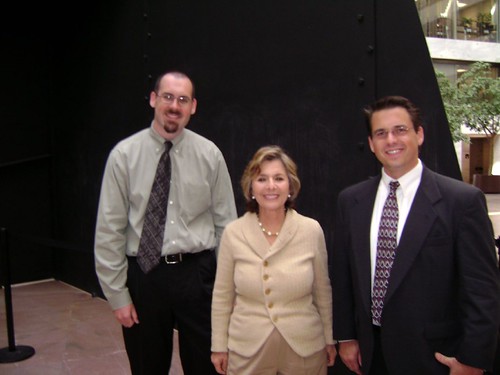 Check out how slumped over I am in this photo. Note to self: next time straiten up a bit... the back AND the tie. Sheesh!
So what were the meetings like? They varied considerably. From a 5 minute hallway chat to a leisurely discussion on comfy chairs to a conversation in a coffee shop (yes, that was with a staffer from Washington State), the venue changed. The message was the same. My pitch went something like this:
Hello, I'm Thomas Robey and am Washington State's newest bioengineering PhD. While I was a graduate student I was supported by two different NIH research grants, and as a medical student in the NIH funded MD/PhD program am the beneficiary of another. For the last four years I have been working on a project to restore cardiac function after heart attacks using human embryonic stem cells. I used one of the lines approved for federal funding. What is really exciting is that the team I am a part of has been able to grow human heart tissue in mice and rats that have heart attacks. This has helped the injured rodent hearts pump better, too. Unfortunately, we only have access to a very small number of cell lines - smaller even than the 12 or so that are readily available. It turns out that the lines made before August 9 are not the best to do research with. We are looking forward to a policy change about stem cells! Now that I have finished my PhD, I will be looking to a future when fewer young scientists are able to secure funding. It is important for the NIH funding lines to at least keep up with inflation. (We would like to see the bill in conference to accept the Senate's numbers.) The funding trajectory for the NSF should also be maintained to eventually double its allocations. It is important to understand that the money spent on both basic and applied research pays back into the economy several fold. Thank you for your past support for science, and I am happy to be a resource to you or other staffers should you need information about stem cell or medical science issues.That's about it. Somewhere in there would be the obligatory transfer of business cards, and maybe the staffer would ask a few questions, but 15 minutes later I was on my way. If these meetings were the point of the trip, those would be some pretty expensive minutes. Fortunately, the real value was in training young scientists to speak with congressional staff and creating potentially lasting relationships between scientists and policy-makers. I will touch on that more in a future post, but for now, I need to submit my travel expenses - oh yeah, you can apply for travel awards from the JSCPP...
*I think it's fair in science to categorize 29 as young!
Friday, September 21, 2007
Hill Day Snippets
I've been working on a nice report for y'all from my visit on Wednesday to Capitol Hill, but before I post the complete digest, I'll share with you a few sound bites and juicy tidbits.
- I think I met Kate from the Anterior Commissure, but didn't even know it at the time.
- "I'm supported by the NIH. We're working on ways that human embryonic stem cells might be used to treat heart attacks. Please vote to keep funding science."
- The weather was amazing. 80 degrees, mostly sunny, only a little humid. A beautiful Seattle summer day (but with extra haze).
- I learned about the Jena 6.
- Next time, don't use homemade business cards.
- FOSEP Director Reunion!
- "Is Representative Cubin in? I attended medical school with her son."
- I recommend the National Museum of the American Indian.
- Barbara Boxer patted my arm and told me to "Keep up the good work."
- It's all in the relationships you build on these sorts of trips, not the exact wording of your message.
Wednesday, September 19, 2007
On the Hill
Today, I am in the other Washington visiting the my senators and representative (or their staffs) to advocate for science. My personal points are simple:
I am here with the Joint Steering Committee for Public Policy. You should consider signing up for their email notification list. (They only send one email a quarter.)
- Continue to increase NIH and NSF funding.
- Ask that the arbitrary limits on human embryonic stem cell research be removed and more logical system of oversight be instituted.
I am here with the Joint Steering Committee for Public Policy. You should consider signing up for their email notification list. (They only send one email a quarter.)
Monday, July 09, 2007
The NIH wants YOU!
 The NIH is seeking comments regarding NIH’s support of the biomedical and behavioral research, including peer review, with the goal of examining the current system to optimize its efficiency and effectiveness. The NIH is especially interested in creative suggestions, even if they involve radical changes to the current approach. Responses will be accepted until August 17, 2007 online or via e-mail (PeerReviewRFI@mail.nih.gov). I hope that all of you reading this - whether you are a grant recipient, a student or a taxpayer - will offer advice to Uncle Sam.
I made this post as part of a pyramid meme initiated by Writedit and sent to me by DrugMonkey, both individuals who know more about the nitty-gritty of NIH grants than myself. If you blog and want to tag yourself to write about this, here are 4 rules:
1. Include in your post the links to the NIH RFI and the comments page.
2. Include the list of six topics the NIH wants information about.
- Challenges of NIH System of Research Support
Please describe any specific challenges presented by NIH’s support of biomedical and behavioral research such as the current array of grant mechanisms, number of grants awarded per investigator, and the duration of grants. - Challenges of NIH Peer Review Process
Please describe any specific challenges presented by the current peer review process at NIH. - Solutions to Challenges
Please concisely describe specific approaches or concepts that would address any of the above challenges, even if it involves a radical change to the current approach. - Core Values of NIH Peer Review Process
Please describe the core values of NIH peer review that must be maintained or enhanced. - Peer Review Criteria and Scoring
Are the appropriate criteria and scoring procedures being used by NIH to evaluate applications during peer review? If not, are there changes in either that you would recommend? - Career Pathways
Is the current peer review process for investigators at specific stages in their career appropriate? If not, what changes would you recommend?
4. Decide who the next seven vectors will be for this meme.
I decided to forward this request to 7 other bloggers. The lucky winners here are:
The Daily Transcript
King of the Nerds
The Scientific Activist
Pimm
Science to Life
SeattleJew
Neurotopia
Check their sites to learn more about other folks' ideas, but most importantly, comment to the NIH!
Sunday, June 10, 2007
Science Policy Tracker
Want to know what science-related bills are being debated in Congress? The American Association for the Advancement of Science tracks everything nicely at this website.
Remember that if you contact your legislators about these (or any other) issues, use email, the telephone or fax your letter. Since the anthrax incident, paper mail takes FOREVER to get through.
Remember that if you contact your legislators about these (or any other) issues, use email, the telephone or fax your letter. Since the anthrax incident, paper mail takes FOREVER to get through.
Sunday, May 13, 2007
Competitiveness
Now's as good a time as any for an entry about competitiveness.
For those of you that are not science policy wonks, competitiveness is a term that is often applied to science funding. For future reference, another code word for science funding is innovation. Anyway, a spate of supra-majority supported legislation has emerged from the Democratic controlled congress that would increase allocations to just about every federal agency that funds science. (Note that the National Institutes of Health is funded by its own mechanisms and is not touched by these bills.) The Bush Administration is committed to a veto because of "excessive and inappropriate" spending levels and that the bills create "unnecessary bureaucracy."
What's the scoop on these veto-proof measures?
S.761 "America COMPETES" passed 88-8 and would:
H.R. 363 would increase financial support for young investigators (that's me!) and passed 389-22.
The House also has some upcoming votes on science funding for NSF, NIST, DOE, DOD, XYZ and LMNOP.
In contrast, the executive branch would have NSF's and others' funding double in 10 years as part of the 2006 State of the Union-touted American Competitiveness Initiative. It turns out that the Congress has followed the 2005 National Academies' recommendation much more closely than the Administration.
But really, what do you expect that scientists will ask for when asked other than more money?
A good chunk of my information for this entry came from the subscription-only Science Magazine.
For those of you that are not science policy wonks, competitiveness is a term that is often applied to science funding. For future reference, another code word for science funding is innovation. Anyway, a spate of supra-majority supported legislation has emerged from the Democratic controlled congress that would increase allocations to just about every federal agency that funds science. (Note that the National Institutes of Health is funded by its own mechanisms and is not touched by these bills.) The Bush Administration is committed to a veto because of "excessive and inappropriate" spending levels and that the bills create "unnecessary bureaucracy."
What's the scoop on these veto-proof measures?
S.761 "America COMPETES" passed 88-8 and would:
- Double National Science Foundation funding in 5 years
- Boost funding at the Dept. of Energy and Nat'l Institute of Standards and Technology
- Increase funding for science education programs from K-graduate school.
H.R. 363 would increase financial support for young investigators (that's me!) and passed 389-22.
The House also has some upcoming votes on science funding for NSF, NIST, DOE, DOD, XYZ and LMNOP.
In contrast, the executive branch would have NSF's and others' funding double in 10 years as part of the 2006 State of the Union-touted American Competitiveness Initiative. It turns out that the Congress has followed the 2005 National Academies' recommendation much more closely than the Administration.
But really, what do you expect that scientists will ask for when asked other than more money?
A good chunk of my information for this entry came from the subscription-only Science Magazine.
Thursday, May 03, 2007
Reporting Research Funding
The latest addition to the Northwest's journalism community is an online paper that focuses on "news of the great nearby." The great part refers I suppose to the Northwest... In principle, I like the idea of focusing news presentations on issues that make a difference in our region. The Crosscut staff is led by David Brewster and is composed of some Seattle reporting legacy characters, most notably Knute "Skip" Berger who now goes as Mossback.
In the first original Crosscut material I've seen that has to do with the science conducted in the Northwest, Brewster reports an uninspired list of statistics that is essentially a data table put into sentences. The bottom line is that universities in the Northwest are doing pretty well in attracting federal funds for science research - except for Idaho.
For example, it might be worth pointing out that all of the states ahead of Washington have two to five times the number of 'R01' (large research) universities as in WA. Other consequences of funding could be explored, such as keeping the NW a vibrant research community for young scientists, entrepreneurs and leaders in scientific research. How do these numbers compare in per capita?
What of the political implications of rankings like these? I would appreciate reporting what these rankings mean for state support for public higher ed. The UW has a tough time every biennium getting its budget approved by the legislature. Is this due to the surprisingly low percentage of state legislatures who have college degrees? What is state funding like in other NW states? Is Alaska's successful growth in receiving federal funds related to increases there in state allocation to research? Could this relate to Washington's plans to spend tobacco settlement money on the Life Sciences Initiative?
It is important for the public to know what great institutions of learning we have in our backyards, so I appreciate the coverage. It just seems like a little more work would have made a lot more informative article.
In the first original Crosscut material I've seen that has to do with the science conducted in the Northwest, Brewster reports an uninspired list of statistics that is essentially a data table put into sentences. The bottom line is that universities in the Northwest are doing pretty well in attracting federal funds for science research - except for Idaho.
For example, it might be worth pointing out that all of the states ahead of Washington have two to five times the number of 'R01' (large research) universities as in WA. Other consequences of funding could be explored, such as keeping the NW a vibrant research community for young scientists, entrepreneurs and leaders in scientific research. How do these numbers compare in per capita?
What of the political implications of rankings like these? I would appreciate reporting what these rankings mean for state support for public higher ed. The UW has a tough time every biennium getting its budget approved by the legislature. Is this due to the surprisingly low percentage of state legislatures who have college degrees? What is state funding like in other NW states? Is Alaska's successful growth in receiving federal funds related to increases there in state allocation to research? Could this relate to Washington's plans to spend tobacco settlement money on the Life Sciences Initiative?
It is important for the public to know what great institutions of learning we have in our backyards, so I appreciate the coverage. It just seems like a little more work would have made a lot more informative article.
Thursday, February 08, 2007
Is Big Science is Here to Stay?
Reported in the New York Times today is a story about a planned $6.7 billion 20 mile long supercollider. It's no Superconducting SuperCollider (Cancelled by the US Congress in '93), but is seems pretty cool to me.
The most interesting paragraph in the article is:
Can you guess which phrase made me laugh? You win a prize if you identified "ultimate truth about nature." Wow. We've got the credibility of the most famous scientist ever, conjuring of Hollywood's fireball special effects, the elusive dream of time travel, questions of origins of existence, and to top it off, the answer to life, the universe and everything!
Gee, $6.7 billion seems like a deal to get all of that!
The most interesting paragraph in the article is:
Particle accelerators derive their punch from Einstein’s equation of mass and energy. The more energy they can pack into their little fireballs, the farther back in time they can go, closer and closer to the Big Bang and perhaps ultimate truth about nature, recreating particles and laws that once ruled the cosmos, but have since vanished more completely than the dinosaurs. But as physicists have pushed inward and backward, their machines have gotten bigger and more expensive.
Can you guess which phrase made me laugh? You win a prize if you identified "ultimate truth about nature." Wow. We've got the credibility of the most famous scientist ever, conjuring of Hollywood's fireball special effects, the elusive dream of time travel, questions of origins of existence, and to top it off, the answer to life, the universe and everything!
Gee, $6.7 billion seems like a deal to get all of that!
Saturday, February 03, 2007
Obama on Science Funding
In my first overtly political post, I have chosen to include text from Barack Obama's The Audacity of Hope. I was struck by how in two pages he:
This is from pages 165-167.
Okay... I could be convinced that breakthroughs in science and engineering could figure out great new ways to fill in those potholes.
Obama
- Outlined a brief history of government sponsored research.
- Relayed a personal vignette of a conversation with one of the world's top scientists.
- Offered hope for a plan to reinvgorate academic research.
This is from pages 165-167.
There's one other aspect of our educational system that merits attention - one that speaks to the heart of America's competitiveness. Since Lincoln signed the Morrill Act and created the system of land grant colleges, institutions of higher learning have served as the nation's primary research and development laboratories. It's through these institutions that we've trained the innovators of the future, with the federal government providing critical support for the infrastructure – everything from chemistry labs to particle accelerators – and the dollars for research that may have an immediate commercial application but that can ultimately lead to major scientific breakthroughs.
Here, too, our policies have been moving in the wrong direction. At the 2006 Northwestern University commencement, I fell into a conversation with Dr. Robert Langer, an Institute Professor of chemical engineering at MIT and one of the nation's foremost scientists. Langer isn't just an ivory tower academic – he holds more than five hundred patents, and his research has led to everything from the development of the nicotine patch to brain cancer treatments. As we waited for the procession to begin, I asked him about his current work, and he mentioned his research in tissue engineering, research that promised new, more effective methods of delivering drugs to the body. Remembering the recent controversies surrounding stem cell research, I asked him whether the Bush Administration's limitation on the number of stem cell lines was the biggest impediment to advances in his field. He shook his head.
“Having more stem cell lines would definitely be useful,” Langer told me, "but the real problem we're seeing is significant cutbacks in federal grants." He explained that fifteen years ago, 20 to 30 percent of all research proposals received significant federal support. That level is now closer to 10 percent. For scientists and researchers, this means more time spent raising money and less time spent on research. It also means that each year, more and more promising avenues of research are cut off – especially the high-risk research that may ultimately yield the biggest rewards.
Dr. Langer's observation isn't unique. Each month, it seems, scientists and engineers visit my office to discuss the federal government's diminished commitment to funding basic scientific research. Over the last three decades federal funding for the physical, mathematical, and engineering sciences has declined as a percentage of GDP - just at the time when other countries are substantially increasing their own R & D budgets. And as Dr. Langer points out, our declining support for basic research has a direct impact on the number of young people going into math, science, and engineering which helps explain why China in graduating eight times as many engineers as the United States every year.
If we want an innovation economy, one that generates more Googles each year, then we have to invest in our future innovators by doubling federal funding of basic research over the next five years, training one hundred thousand more engineers and scientists over the next four years, and providing new research grants to the most outstanding early-career researchers in the country. The total price tag for maintaining our scientific and technological edge comes out to approximately $42 billion over five years - real money, to be sure, but just 15 percent of the most recent federal highway bill.
In other words, we can afford to do what needs to be done. What's missing is not money, but a national sense of urgency.
Okay... I could be convinced that breakthroughs in science and engineering could figure out great new ways to fill in those potholes.
Obama
Subscribe to:
Posts (Atom)


