In relation to this week's Earth Day the New York Times is running a comparison between the energy costs of stainless steel water bottles and disposable plastic ones. Given the intensive energy input to steel production, it will take between 50 and 100 reuses of the steel water bottles to balance out an equivalent usage of disposable bottles. That seems reasonable enough to me. In my water drinking prime, I refilled my Nalgene bottle twice a day, which was the volume equivalent of 4 or 5 disposables. The problem I have with this analysis is that the author used disposable plastic as a straw man. I'd like to see the balance between a stainless steel container and the polycarbonate bottles that you can use just as much. I know, if you drink 6.02x10^23 liters of water from polycarbonate bottles, you might get cancer. But there are other durable plastic choices.
There's another kicker in the feature (that seems a little off): the carbon costs of marketing and storing a steel bottle on the shelf of an REI or equivalent store may be as much as producing it in the first place!
The bottom line seems to me to be: Use old stuff. Reusing anything is better than buying a new 'green' object. The worst steel bottles are the red colored ones - every time I see someone drink from one, I think, "Noooo! Don't drink that kerosene!" But that's just the Boy Scout in me...
Showing posts with label carbon footprint. Show all posts
Showing posts with label carbon footprint. Show all posts
Sunday, April 19, 2009


Wednesday, February 04, 2009
Residency Interviews
Finished with interviews for 3 weeks and I'm still brimming over with thoughts about the process. This time, I'm concerned about my horrible carbon footprint secondary to traveling to so many cities. Read about it at The Differential.
 You may need to sign up for a free account.
You may need to sign up for a free account.Sunday, January 18, 2009
I Would Walk How Many Miles?
I'm working on a post over at The Differential about all the traveling I've been doing to interview at residencies around the country, and am curious about the number of miles that residency applicants travel (by plane, train or auto) in a given interview season. Anyone have any ideas?
Wednesday, June 11, 2008
Reducing and Reusing, if not Recycling in the OR
Over at The Differential, I recently wrote about waste in medicine; lots of stuff gets thrown away, especially in hospitals. One of medicine's most egregious offenders is the OR. Items ranging from blue towels to cautery equipment to paper drapes to laparoscopic instruments to suture to bowel staplers all are pitched at the end of each case. In the past few weeks I've enlisted the help of scrub techs and circulating nurses to cut down on the footprint of the cases I'm involved with. Here's what we came up with in the reusing category:
Recycling will be a tough thing to implement in the OR. Most paper gets contaminated with blood, poop or iodine. I don't think we want that stuff getting into the recycling waste-stream. In the end though, shouldn't reducing and reusing decrease carbon footprint even more than recycling? Anyone have other ideas about reducing waste in the OR? Or in the hospital?
- Suction irrigators run on 8 AA batteries and are designed to run for two hours. After the case, the irrigator is pitched - including the pump. If you salvage the batteries from each suction irrigator used for ectopic pregnancy or cholecystectomy cases you assist with, you'll amass 10 hours of digital camera usage per irrigator, or put another way, a lifetime powering of remote controls per surgery clerkship.
- Blue towels are the sterile, lint free linens that surgeons dry their hands and arms on after scrubbing but before donning gown and gloves. For folks like me, who 'scrub' using the germicidal alcohol-based Avagard chlorhexidine cleanser and come into the room 'dry,' there's a good chance that towel will go unused in the case. This makes a perfect car-drying towel. (For after you go through the automatic car washes, of course - they save water and reduce toxic runoff.)
- Specimen containers are especially useful for my natural history collections. (See my entries on Wunderkammern for clarification.) The sterile cylindrical canister that comes with Foley catheter kits is good for spices when you go camping. Unused but opened pathology specimen containers work well for storing small parts. Any clean container works well for storing captured insects or categorizing bark samples or some other random hobby.
- Sutures are thrown away all the time. Many ORs save the packets for student use and practice. Before grabbing extras off of the scrub tech's Mayo tray, be sure to ask. Not only because there's a chance open suture is contaminated with patient parts, but NEVER TAKE ANYTHING FROM THE SCRUB TECH'S MAYO TRAY!
Recycling will be a tough thing to implement in the OR. Most paper gets contaminated with blood, poop or iodine. I don't think we want that stuff getting into the recycling waste-stream. In the end though, shouldn't reducing and reusing decrease carbon footprint even more than recycling? Anyone have other ideas about reducing waste in the OR? Or in the hospital?
Sunday, April 20, 2008
The Green Service
I'd encourage you to consider taking a little time this week to read some of the articles in the New York Times' Green Issue that they've published in honor of Earth Day. In the interest of mixing things up a bit, I've taken the liberty to arrange some of my favorite articles and features into the structure of a church service.
Where I go to church, the service starts with singing. In churchgoer lingo worship is a way to transition from the business of the week or the day and focus on the time you plan to spend meditating, learning, reflecting and challenging the ideas that will come of the service. Worship can be just song, but could also include projected artwork, dramatic readings, instrumental expression or even dance. The online version of the green issue includes a funky tribute to the sculptures used as headings throughout the article.
Every church service features a scripture reading, whether it be from a pre-determined yearly schedule or selected by that day's service leaders. In most Christian traditions, this includes readings from the Old and New Testaments. It was reading some of the entries in the ACT/ EAT/ INVENT/ LEARN/ LIVE/ MOVE/ BUILD sections that I though of this theme. Scripture readings are small snippets from the Bible that can then offer digestible ideas for study or contemplation. Of these, I recommend the LIVE and INVENT sections.
For the personal testimony, head over to Pasadena, CA where the Dervaes family has gone 'off the grid.' As my wife listened to the video report with me, she pointed out, "Those people used to be called Hippies." Maybe so, but these days, there's a lot more hip to what they are doing. Contrast their strategy with the way rich folks go green a la Bill Nye.
The sermon, tucked in toward the end of the service, centers on the motivation, justification, and implementation of individual efforts to curb fossil fuel consumption and carbon emission. The garden is rich with metaphor. The seed and sower have a long tradition in secular and religious texts. Michael Pollan provides a fresh take on the garden as a social force for lessening climate change.
Finally, for the benediction, I quote Rabbi Julian Sinclair:
Where I go to church, the service starts with singing. In churchgoer lingo worship is a way to transition from the business of the week or the day and focus on the time you plan to spend meditating, learning, reflecting and challenging the ideas that will come of the service. Worship can be just song, but could also include projected artwork, dramatic readings, instrumental expression or even dance. The online version of the green issue includes a funky tribute to the sculptures used as headings throughout the article.
Every church service features a scripture reading, whether it be from a pre-determined yearly schedule or selected by that day's service leaders. In most Christian traditions, this includes readings from the Old and New Testaments. It was reading some of the entries in the ACT/ EAT/ INVENT/ LEARN/ LIVE/ MOVE/ BUILD sections that I though of this theme. Scripture readings are small snippets from the Bible that can then offer digestible ideas for study or contemplation. Of these, I recommend the LIVE and INVENT sections.
For the personal testimony, head over to Pasadena, CA where the Dervaes family has gone 'off the grid.' As my wife listened to the video report with me, she pointed out, "Those people used to be called Hippies." Maybe so, but these days, there's a lot more hip to what they are doing. Contrast their strategy with the way rich folks go green a la Bill Nye.
The sermon, tucked in toward the end of the service, centers on the motivation, justification, and implementation of individual efforts to curb fossil fuel consumption and carbon emission. The garden is rich with metaphor. The seed and sower have a long tradition in secular and religious texts. Michael Pollan provides a fresh take on the garden as a social force for lessening climate change.
Finally, for the benediction, I quote Rabbi Julian Sinclair:
“The environmental movement has been overwhelmingly secular for 40 years and has achieved amazing things,” he says, “but it hasn’t yet figured out how to move people on a massive scale because it isn’t telling the right story.’ Sinclair says he believes that the “doom-laden apocalyptic narrative” favored by the mainstream environmental movement can paralyze rather than motivate necessary lifestyle adjustments. Conversely, he says religion — which has been “in the behavioral-change business for 3,000 years” — offers a distinct message of hope and boasts an impressive track record of moral persuasion: “There have been watershed moments when religion has barged into public life, blown away the windbaggery of politics-as-usual and declared with irresistible force, ‘This must change now!’ ”
Tuesday, February 19, 2008
Passing (on) Gas
Are you as alarmed as I am about the cost of oil reaching $100 a barrel? Chances are good that you're just worried about 87 octane costing $3.00 a gallon. What are we going to do about it? I've been carpooling. But that's a pretty short term fix. Jonathan Golob (known to some as Seattle's only scientist) has put together a nice little call to arms over at his blog. In a rally the troops approach, he's thinking about environmentally friendly potential of oil shale and coal as dominant American energy sources. It's easier for me to get behind other (closer to implementation) innovations like residential solar, wind, and even geothermal production than by ravaging the land for its energy. But that doesn't mean you shouldn't surf on over to DearScience to read what he has to say. And after you're done there, go over to the World's Fair for an excellent essay linking $100 oil with Cuba.
Sunday, December 30, 2007
Christmas Lights
Do you live in the Bay Area? Have you not yet had your fill of Christmas Lights? Do you have a tank full of $3.50-a-gallon 87 octane anxious to be incinerated? If your answer to these questions is yes, consider driving to 2724 Ascot Drive; San Ramon, CA. This writer (known to some in my family as "Mr. Cynical Christmas") drove there twice. Add hypocritical to that moniker. Anyway, once you are there, tune in to 100.7 FM. If you want to surprise yourself, read no further. If you are actually thinking of going, don't worry - it's much cooler in person! If you only want to take a virtual trip to this fantastic display, please enjoy the following videos from YouTube.
First, you will need to check your processor speed.
Act One: 34th Street Overture
Act Two: Carol of the Bells
Act Three: Illuminations

In the end, I was just as happy with a failed attempt to find the two western screech owls hooting in the trees above my parents' house. In the process, I only scared one of their neighbors.
I hope this post was random enough for you.
Goodnight.
Sunday, September 23, 2007
Carbon Footprint: Doha and Dalian
It's been a little while since I wrote anything about carbon footprint. This post will make you think about whether I should even bother. NYTimes correspondent Thomas Friedman is concerned about climate change, but he suggests (as some of my readers have) that the current American approach to the issue (tips about how you and I can reduce our individual consumption) isn't cutting it. By the way, Doha is the capital of Qatar and Dalian is in China's Silicon Valley; both have experienced enormous growth over the past years. Friedman writes:
Hey, I'm really glad you switched to long-lasting compact fluorescent light bulbs in your house. But the growth in Doha and Dalian ate all your energy savings for breakfast. I'm glad you bought a hybrid car. But Doha and Dalian devoured that before noon. I am glad that Congress is debating whether to bring U.S. auto mileage requirements up to European levels by 2020. Doha and Dalian will have those gains for lunch -- maybe just the first course. I'm glad that solar and wind power are "soaring" toward 2 percent of U.S. energy generation, but Doha and Dalian will devour all those gains for dinner. I am thrilled that you are now doing the "20 green things" suggested by your favorite American magazine. Doha and Dalian will snack on them all, like popcorn before bedtime.A free copy of the entire editorial can be read at today's Seattle Post-Intelligencer. Also, check out a short video of Friedman explaining his views about what he calls the "Power of Green" and industrial growth.
Friday, August 31, 2007
Carbon Footprint: SUVs vs. Cows
I am glad to be able to link Dr. Free-Ride in today's carbon footprint entry - mostly because today is a 'get your dissertation talk ready' day. She follows up (probably unknowingly) on my entry last week about cow farts with a well thought-out post comparing the switch from an SUV to a compact car with switching from meat to veggies for protein. In reality, she is responding to an interesting but scientifically uncritical analysis of the situation recently printed in the NYTimes.
Friday, August 24, 2007
Carbon Footprint: Electronic Statements
 This week, my tip for greener living is brief. Consider paying your bills online or use automatic deductions to reduce the paper use and the gas needed to deliver the outgoing mail. Depending on your municipality and bank, you can pay electric, water, cable TV, phone, credit card, association fee, newspaper, insurance, mortgage, and internet provider bills using automatic deductions from your checking account or credit card statement. We save several dollars a month in postage and maybe an hour of work each month. Some agencies still send statements in the mail; the only difference is that the statements now say “Do not Pay. Automatic Deduction.” Several agencies will et you sign up for a electronic statement, further reducing the paper needed. Trees are saved from the paper mill so they can do their jobs of providing shade, absorbing solar heat and cleaning the air. Furthermore, there is less demand for paper, which reduces manufacturing energy. Try to remove yourself from bulk mailing lists and keep a recycling bin next to your front door so that junk gets diverted immediately to the circular file.
Thanks to Evelyn the Envelope for agreeing to pose for this week's clip art.
Friday, August 17, 2007
Carbon Footprint: Cow Farts
Carbon dioxide is not the only culprit in global warming. There are other gasses responsible for insulating the atmosphere, and some of them could be reduced by curbing meat consumption.
You may not know that the international meat industry produces 18% of the world’s greenhouse gas emissions. Sure this calculation includes CO2 released in the shipping of feed and stock, feed crop fertilization and farm machinery operation, but you probably did not know that livestock contribute to global warming in an entirely different (if more natural) way. Some of the global warming from farming comes from the methane released by cattle and the nitrous oxide in manure. It seems Ronald Reagan was right about cow farts.
You may not know that the international meat industry produces 18% of the world’s greenhouse gas emissions. Sure this calculation includes CO2 released in the shipping of feed and stock, feed crop fertilization and farm machinery operation, but you probably did not know that livestock contribute to global warming in an
 entirely different (if more natural) way. Some of the global warming from farming comes from the methane released by cattle and the nitrous oxide in manure. It seems Ronald Reagan was right about cow farts.
 About 30 percent of the methane in the atmosphere results from microbial action in animals' digestive tracts. This prompted Ronald Reagan's dismissive comment that humans couldn't be held accountable for global-warming gases (of which methane is the most potent), because the most significant source is bovine flatulence.Methane has a warming effect 23 times as great as that of carbon, while nitrous oxide is 296 times as great. So not only is reducing meat consumption better for the average American's health, good for watersheds and important for balancing grain for human consumption with feed for animals, it reduces the demand for flatulence-prone livestock.
As contemporary critics noted, however, Reagan overlooked the fact that animal husbandry has vastly increased the number of cattle, making cow farts very much a human-influenced commodity.
Friday, August 10, 2007
Carbon Footprint: Food Miles
 Today's carbon footprint column is short and sweet. Food miles is still a new concept for do-it-yourself environmentalists, so is worth another spin. Buying from markets and fruit stands makes for tastier meals, connects you to your environment, and is healthy for the local food industry. But if its the food miles you want to figure out, read these:
- A New York Times opinion piece by James McWilliams defines food miles.
- Benjamin Cohen at The World's Fair expands on the concept with an insightful analysis.
Friday, August 03, 2007
Carbon Footprint: Compact Fluorescence
 When I saw this New Yorker cover over at The World's Fair, I knew I needed to use it for a column about compact fluorescent bulbs. This week is the perfect week for it. Not only did I renew a few fixtures in my apartment this morning with CFBs, King of the Nerds (who last week was promoted to represent all of science in a column called Dear Science) offered Seattle's lighting Luddites fuel for the anti-conservationist fire. (Warning: while Nerd is a gentleman and refrains from profanity, his newspaper's readers are/do not, so beware of following that link!)
The question here is whether Americans are willing to pass up on incandescent bulbs for compact fluorescent ones. The cons for switching include:
- The strange light looks funny, buzzes, gives me headaches, and induces seizures.
- If I break the bulbs, I'll inhale mercury and turn into a drooling idiot.
- Power in the Northwest doesn't come from carbon anyway, so why bother?
- All of my fixtures are three-way switches or dimmers.
- I can't throw my old CFBs in the trash. What a drag!
- Go buy a new bulb (not that one you got free from the power company in 2000) and try it out. You will be impressed by its silence and light quality.
- The Nerd writes,
While new compact fluorescent bulbs are voluntarily limited to five milligrams of mercury each, as little as a tenth of a milligram per square yard will make you seriously ill.
Note to copy editor: please change 'will' to 'could.' Even 'could' is too strong a word. Seriously ill was probably caused from direct ingestion or inhalation of the entire quantity prepared in its most bioactive state. (Feel free to chime in if you can clarify this!) For reference, 5 mg is 1% of what mercury thermometers contained. Yes there IS mercury, so you should follow these instructions in the rare event that a bulb breaks. The Nerd also insinuates that CFBs throw off UV light. Read that part carefully: UV is like a catalyst for the light that actually comes out. When was the last time you got sunburned in the office? As far as the drooling idiot is concerned, I'm not sure if new bulbs could fix the Nerd's questioner. - We do use water to fuel our consumptive power habits, but what about all of those folks in Wyoming or Michigan that burn coal? If we don't use our extra power here, guess who we sell it to?
- Contrary to popular opinion, there are CFBs rated for dimmers and three way switches.
- In the United States, use this helpful guide to find out where your bulbs should be disposed of. In Seattle, go here or here.
Don't forget that you can also turn off your compact fluorescent lights when they are not in use!
Friday, July 27, 2007
Carbon Footprint: Cell Phone Chargers
Sorry for the skipped entry in the Carbon Footprint series. My footprint totally died and I had to recharge it for, like, two weeks.
 Which brings us to this week's recommendation: battery chargers. Did you know that chargers use power even when the electronic device is not plugged in? In fact, 95% of the energy used by mobile phone chargers is wasted. Why is this? Most electronics these days use batteries, and batteries need direct current for charging. That little black box that blocks the other outlet whenever it's plugged in does not 'know' if the phone is plugged in at the other end; it just goes about its business converting alternating current from the socket into low voltage direct current for your battery. This activity is called a phantom load. This kind of appliance is known in green circles as a vampire.
My AC adapter is rated at 4.8 volts and a 350 mAmp current. That means that fully loaded the phone's battery resistance is almost 14 Ohms. Ohm, my! When the phone is not plugged in, the resistance has to be much lower, especially since the voltage from the wall is 120V, and according to some engineers at Cambridge, a lonely charger sucks a miniscule 0.472 Watts. Even so, according to a CNN article, chargers of all kinds make up fully 5% of your electricity bill every month. Unplugging them is an easy way to cut your bill and your carbon use. Plus, it will be easier to use other devices in the outlet without that bulky plug in the way.
Update 8/19/07: I have altered this column slightly to address concerns of accuracy brought up in the comments below.
 Which brings us to this week's recommendation: battery chargers. Did you know that chargers use power even when the electronic device is not plugged in? In fact, 95% of the energy used by mobile phone chargers is wasted. Why is this? Most electronics these days use batteries, and batteries need direct current for charging. That little black box that blocks the other outlet whenever it's plugged in does not 'know' if the phone is plugged in at the other end; it just goes about its business converting alternating current from the socket into low voltage direct current for your battery. This activity is called a phantom load. This kind of appliance is known in green circles as a vampire.
My AC adapter is rated at 4.8 volts and a 350 mAmp current. That means that fully loaded the phone's battery resistance is almost 14 Ohms. Ohm, my! When the phone is not plugged in, the resistance has to be much lower, especially since the voltage from the wall is 120V, and according to some engineers at Cambridge, a lonely charger sucks a miniscule 0.472 Watts. Even so, according to a CNN article, chargers of all kinds make up fully 5% of your electricity bill every month. Unplugging them is an easy way to cut your bill and your carbon use. Plus, it will be easier to use other devices in the outlet without that bulky plug in the way.
Update 8/19/07: I have altered this column slightly to address concerns of accuracy brought up in the comments below.
Sunday, July 08, 2007
Carbon Footprint: White Roofs
Now that the summer has had a couple of serious heat waves, it's a good time to talk about how we Americans need our cool refuges from the hot and humid air. One obvious strategy to reduce your carbon footprint is to turn down the A/C or keep it from running when you are not at home. This keeps carbon from the atmosphere and dollars in your pocket.
But here's another creative solution: The next time you re-shingle your home, consider light colored material; White tile, silver paint, or cedar shakes each have a high reflective index. Instead of absorbing all of that energy and transferring it into the buildings below, as much as 15% of total energy could be reflected back into space. White roofs do the same thing as clouds and snow, in that they reflect incident energy like a mirror. The quantity of total energy reflected is referred to as albedo. White surfaces have very high albedos for light in the visual range, but are less efficient at reflecting ultraviolet or infrared wavelengths (hence the ~15% value cited above).
Evidently, there is a movement afoot to design new roofing materials that reflect light not only in the visual range, but in the longer more energetic wavelengths. These could be used as tiles to keep homes and other buildings more energy efficient. California is also sponsoring research that could make pavement more reflective. Combined with lighter roofs, this could go far in reducing the heat islands that form in urban areas. It's hotter in cities because more energy is absorbed by man made structures! And in heat waves, we have to cool those structures.
So painting your roof white may not have an immediate impact on your carbon footprint, but it should keep your cooling bills down in the summer. Now whether any of you cold winter dwelling folk benefit from darker roofs in the winter is something I don't know. Having done my fair share of attic crawling as a boy, my experience with dark colored roofs is that attics always got really hot in the summer, yet retained frigidity in the winter.
I found some fuzzy math on this subject in an article in Business Week, and a lot of commentary on it at the Island of Doubt, so if you are interested in this issue or are considering a new roof, check those sources out first.
But here's another creative solution: The next time you re-shingle your home, consider light colored material; White tile, silver paint, or cedar shakes each have a high reflective index. Instead of absorbing all of that energy and transferring it into the buildings below, as much as 15% of total energy could be reflected back into space. White roofs do the same thing as clouds and snow, in that they reflect incident energy like a mirror. The quantity of total energy reflected is referred to as albedo. White surfaces have very high albedos for light in the visual range, but are less efficient at reflecting ultraviolet or infrared wavelengths (hence the ~15% value cited above).
Evidently, there is a movement afoot to design new roofing materials that reflect light not only in the visual range, but in the longer more energetic wavelengths. These could be used as tiles to keep homes and other buildings more energy efficient. California is also sponsoring research that could make pavement more reflective. Combined with lighter roofs, this could go far in reducing the heat islands that form in urban areas. It's hotter in cities because more energy is absorbed by man made structures! And in heat waves, we have to cool those structures.
So painting your roof white may not have an immediate impact on your carbon footprint, but it should keep your cooling bills down in the summer. Now whether any of you cold winter dwelling folk benefit from darker roofs in the winter is something I don't know. Having done my fair share of attic crawling as a boy, my experience with dark colored roofs is that attics always got really hot in the summer, yet retained frigidity in the winter.
I found some fuzzy math on this subject in an article in Business Week, and a lot of commentary on it at the Island of Doubt, so if you are interested in this issue or are considering a new roof, check those sources out first.
Friday, June 29, 2007
Misused Math
This morning, I received an anonymous comment on my post about farmers' markets and eating local. The post made from Alexandria, VA (Thank you SiteMeter!) at 3:30 AM Eastern Daylight Time links to a site that informs us of "which states are greener." The content doesn't have much to do with farmers' markets and would probably be better placed on my Live in the Northwest entry, but I checked it out anyway. It turns out that this site is a commercial supplier of solar panels called Hughes Solar Energy, that is based in... Alexandria, VA. It looks like this company is in the business of selling anything that could be remotely tied to solar power.
The section of the website referred to us offers a list all of the states and ranks them according to total carbon output. That metric is useful if you are an energy company marketing low carbon generators (like solar panels), but in terms of modifying individual behavior and identifying where meaningful mitigation can occur, it is useless. What you need to look at is per capita emissions. That number says something about where energy consumption can be improved. So I took 15 minutes to rearrange the data in a spreadsheet so you can see where we need to work the most at reducing emissions. It's also confusing that they order their information using the double negative of "Ranked Worst Pollution." This is the per capita data next to the information from Hughes Solar Energy, and here's a list where you can see which state is beating yours. What a surprise that the rankings nearly inverted! It seems as though high-density blue states use less carbon per capita than the rest of the country.
I remember in 8th grade I had to make a report about how statistics is misused by commercial entities. I think I focused on the Sylvan Learning Center's flawed comparison between American and Japanese school children's workloads and performance. If I were to wite this report over again, this solar energy company's clever (if not disingenuous) presentation of carbon emission data would be my topic!
This is not to say that buying a solar product from Hughes is a bad idea... I just don't like it when people mess around with data to serve their purposes. Okay - when other people mess around with data...
 And don't forget how state emissions values can be altered due to geology. For a while, Mt. St. Helens spewed more carbon than all of the rest of the major polluters in Washington State combined!
The section of the website referred to us offers a list all of the states and ranks them according to total carbon output. That metric is useful if you are an energy company marketing low carbon generators (like solar panels), but in terms of modifying individual behavior and identifying where meaningful mitigation can occur, it is useless. What you need to look at is per capita emissions. That number says something about where energy consumption can be improved. So I took 15 minutes to rearrange the data in a spreadsheet so you can see where we need to work the most at reducing emissions. It's also confusing that they order their information using the double negative of "Ranked Worst Pollution." This is the per capita data next to the information from Hughes Solar Energy, and here's a list where you can see which state is beating yours. What a surprise that the rankings nearly inverted! It seems as though high-density blue states use less carbon per capita than the rest of the country.
I remember in 8th grade I had to make a report about how statistics is misused by commercial entities. I think I focused on the Sylvan Learning Center's flawed comparison between American and Japanese school children's workloads and performance. If I were to wite this report over again, this solar energy company's clever (if not disingenuous) presentation of carbon emission data would be my topic!
This is not to say that buying a solar product from Hughes is a bad idea... I just don't like it when people mess around with data to serve their purposes. Okay - when other people mess around with data...
 And don't forget how state emissions values can be altered due to geology. For a while, Mt. St. Helens spewed more carbon than all of the rest of the major polluters in Washington State combined!
Monday, June 25, 2007
Carbon Footprint: Buy Local Produce
 Here's something to munch on: The average distance (in North America) that your fresh food has traveled by truck or plane to get to your table is 1,000-1,500 miles. You can imagine that more energy is being spent in such transport than in agrarian cultures elsewhere in the world or in our past. Activists have coined a new term surrounding the impact that food transport has on the environment: "food miles." Food miles depend on several factors:
The distance transported.
- The transport mode.
- The concentration of the agricultural product.
- The relative agricultural productivity and the amount of fertilizer required in each location.

 Each of these impacts the amount of carbon emitted to the atmosphere. What makes this issue a little complex is that concentrated or dehydrated foods decrease the amount of energy in shipping fuel, but the energy expended in dehydration, processing or freezing counters such efficiency gains. So what I am about to advocate is a complex issue that you should look into yourself. Here is a nice pro/con article, and here are two food carbon calculators. The second calculator is very detailed but only applies to the UK.
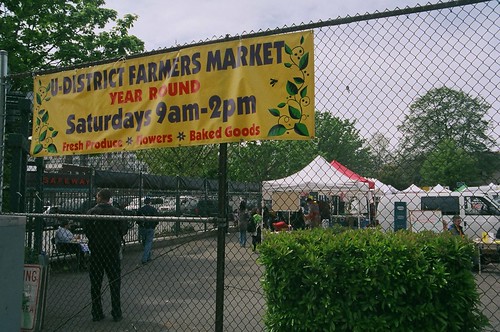
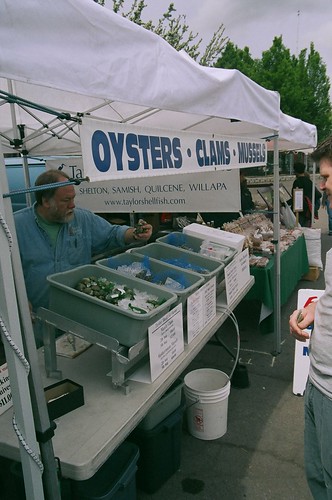
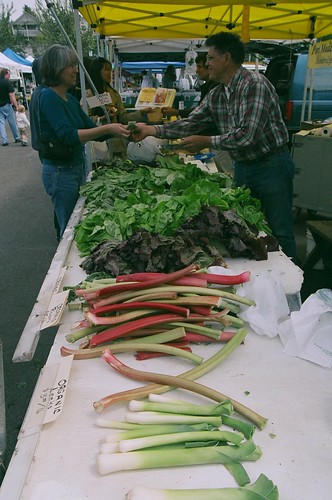 So what is my suggestion for you this week? Buy local produce. Not only will it probably reduce your carbon footprint, you will support diverse local agriculture, your food will be fresher, you will interact with more people, you'll have greater access to organic food, and if you consistently stick to local crop schedules, your diet will be more diverse. The other week, I took some photos of the University District farmers' market. For more, visit my flickr photo set.
Yesterday my wife and I stocked up on fruits, vegetables and kettle corn from the Lake Forest Park farmers' market. It is located in a shopping center adjacent to the Burke-Gilman bike trail, so we were able to pick up our produce without even firing up the horseless carriage. If you are in Seattle or Puget Sound, there are several markets to choose from. Find the closest one here. Some of the farmers will deliver produce weekly to you. One local company might even be advertised in the panel at right. Click on it to learn about them (and to give me a quarter!)
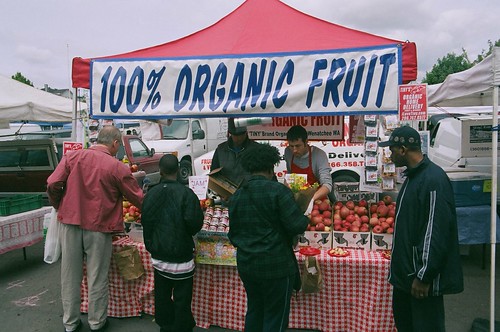 The things about farmers' markets that I used to worry about was cost and spoilage. It is true that you will have to eat fresh fruits from a market sooner than chain-store bought items, but my experience is that they taste a lot better, and you can prolong their shelf life by storing them in the fridge. The veggies - greens and roots - last just as long. I was pleasantly surprised that the farmers markets sometimes SAVE you money! Here is a price comparison of what we bought with our cheapest grocery store:
- $3 of raspberries at the market = $6 at Safeway
- $13 flat of strawberries = $8.50 at Safeway
- $2 of squash = $3.75 at Safeway
- $4 kettle corn at market = unavailable at Safeway
- $1 baby Walla Walla onions = $1 adult onions at Safeway
- $2 baby bok choy = $2 at Safeway
- $3 purple, red and gold potatoes = $4 for gold at Safeway
We might get a third of our produce from local farmers' markets in the summer. In a temperate climate of Seattle, the only excuse for not buying local year round is convenience. Sometimes the only time I have to shop for groceries is between 9 and 11 PM!
There you have it: Eating local is one more way to reduce your carbon footprint. This method seems to have a number of other benefits, too!
Tuesday, June 12, 2007
Carbon Footprint: Low Flow
This is the sixth entry in my series about reducing your personal carbon footprint. So far, I have suggested that you ride the bus, take the stairs, live in the water-powered Northwest, think differently about air travel and recycle aluminum. I enjoy writing these tips; I hope you enjoy reading them. That this is number six also means that I have been keeping up with my regular blogging for almost two months.
Today I want to share with you information that could reduce your carbon footprint, lower your electricity bill and conserve our watersheds. How much? Well... To start, the Department of Energy estimates that electric water heaters are the second biggest energy sink in homes without natural gas. (I am guessing this is after the fridge.) Where does the warmth in that guilty pleasure of a long hot shower come from? In most homes, gas and coal fired power plants. A utilities sponsored study found that a family of four could save 14,000 gallons of water a year just by switching to an energy efficient shower head. This amounts to 21 cents a day on water and 51 cents a day on electricity bills.
Energy efficient shower heads and faucet aerators work by inserting air into the water stream. The contents come out at the same pressure - there is just less water. Evidently, the water cools faster though. According to one site,
Today I want to share with you information that could reduce your carbon footprint, lower your electricity bill and conserve our watersheds. How much? Well... To start, the Department of Energy estimates that electric water heaters are the second biggest energy sink in homes without natural gas. (I am guessing this is after the fridge.) Where does the warmth in that guilty pleasure of a long hot shower come from? In most homes, gas and coal fired power plants. A utilities sponsored study found that a family of four could save 14,000 gallons of water a year just by switching to an energy efficient shower head. This amounts to 21 cents a day on water and 51 cents a day on electricity bills.
Energy efficient shower heads and faucet aerators work by inserting air into the water stream. The contents come out at the same pressure - there is just less water. Evidently, the water cools faster though. According to one site,
if you are tall, you may notice that the water has cooled a little before it reaches your feet.Interesting. Hopefully this fact does not convince my wife that we should not switch the head in our household. But speaking of switching, you can get a FREE aerating shower head by calling 206-684-3800 or emailing rescons.scl@seattle.gov. In addition, many Puget Sound residents will soon be mailed forms with which they can receive two FREE faucet aerators and one shower head. You can go to this website and register before the crowds to make sure you get one. There are also numerous additional tips to reduce your water usage at that site.
Tuesday, June 05, 2007
Carbon Footprint: Stay Grounded
An editorial in today's Seattle Post-Intelligencer induced my choice of this week's Carbon Footprint series. Kathleen Braden, a professor of geography at Seattle Pacific University, relayed her reasoning for not supporting the Sierra Club's efforts to combat global warming because of duplicity between the group's positions and its member services. Don't worry, she doesn't spare other conservation groups that are as two-faced as Janus.
Braden is familiar with the consequences of international travel: she recently gave a seminar about ecotourism in Russia. (The 30 minute talk is available for podcast.) But the central premise of her P-I column was something else - carbon emissions from airplane travel. By offering members vacation travel packages to remote destinations around the world, she calculates that the Sierra Club will add 689 metric tons of carbon dioxide to the atmosphere this year, just so that members can enjoy nature in Nepal or Peru. The same duplicity comes from groups that send plush toys, t-shirts and other packages overnight by air freight to new members.
So what's the take home from this? Are we to take fewer plane trips? Reduce the number of overnight orders? Visit distant family less? The culture of academia is dependent on travel. Just like salesmen, professors travel the country to present their research and ideas to colleagues via conferences or invited seminars. NIH grant review occurs in study sections in Washington DC. Some societies plan 'destination conferences' in Waikiki or Sydney or Venice. On a more personal note, I expect to fly to eight to ten cities next year to interview for residencies. What are we to do about this culture of travel? Whatever it is, it will require system-wide changes in behavior. I am going to start by not worrying whether I will make 'MVP' this year on my Alaska Air frequent flier number. A 14 hour drive to visit my parents? That would be more difficult. And visiting my in-laws in Hawaii... Right now, we are limited by time and finances, so making that trip is still infrequent. Are there any frequent travelers out there - in business or academics - that have found ways to reduce their carbon impact without 'suffering' lost productivity or professional standing?
There's another little pearl from this column that I don't want to overlook, and it ties nicely with a recent post of mine. Here is a Christian - a professor at a Christian college - who is a member of the Sierra Club, the Ocean Conservancy, and probably others that sees no problem between the scientific claims made by these groups and her personal faith. I bet that Kathleen Braden sees her public scholarship on this issue as part of a Christian imperative to be good stewards of the Earth.
Braden is familiar with the consequences of international travel: she recently gave a seminar about ecotourism in Russia. (The 30 minute talk is available for podcast.) But the central premise of her P-I column was something else - carbon emissions from airplane travel. By offering members vacation travel packages to remote destinations around the world, she calculates that the Sierra Club will add 689 metric tons of carbon dioxide to the atmosphere this year, just so that members can enjoy nature in Nepal or Peru. The same duplicity comes from groups that send plush toys, t-shirts and other packages overnight by air freight to new members.
So what's the take home from this? Are we to take fewer plane trips? Reduce the number of overnight orders? Visit distant family less? The culture of academia is dependent on travel. Just like salesmen, professors travel the country to present their research and ideas to colleagues via conferences or invited seminars. NIH grant review occurs in study sections in Washington DC. Some societies plan 'destination conferences' in Waikiki or Sydney or Venice. On a more personal note, I expect to fly to eight to ten cities next year to interview for residencies. What are we to do about this culture of travel? Whatever it is, it will require system-wide changes in behavior. I am going to start by not worrying whether I will make 'MVP' this year on my Alaska Air frequent flier number. A 14 hour drive to visit my parents? That would be more difficult. And visiting my in-laws in Hawaii... Right now, we are limited by time and finances, so making that trip is still infrequent. Are there any frequent travelers out there - in business or academics - that have found ways to reduce their carbon impact without 'suffering' lost productivity or professional standing?
There's another little pearl from this column that I don't want to overlook, and it ties nicely with a recent post of mine. Here is a Christian - a professor at a Christian college - who is a member of the Sierra Club, the Ocean Conservancy, and probably others that sees no problem between the scientific claims made by these groups and her personal faith. I bet that Kathleen Braden sees her public scholarship on this issue as part of a Christian imperative to be good stewards of the Earth.
Monday, May 28, 2007
Carbon Offsets
Summer is here. Those people not finishing up dissertations will be taking vacations. More than last year, folks will hit the roads, rails and flight paths en route to fun. Also, more than last year, there will be increased carbon offset purchasing. The standard scheme involves planting mango trees in India or something to satisfy consumptive lifestyle-choices. Thanks to the movie stars, it's all the rage.
The last few months have seen an increase of more critical stories about this activity. (See an earlier post I made, too.) The metaphor of atonement is a good one. If we ask forgiveness, but don't change our ways, have we really been sincere? Planting trees is just a stop-gap. If you want to offset your carbon load, think about reducing it in the first place.
Okay, enough with the preaching... Have a nice remainder of your holiday!
The last few months have seen an increase of more critical stories about this activity. (See an earlier post I made, too.) The metaphor of atonement is a good one. If we ask forgiveness, but don't change our ways, have we really been sincere? Planting trees is just a stop-gap. If you want to offset your carbon load, think about reducing it in the first place.
Okay, enough with the preaching... Have a nice remainder of your holiday!
Subscribe to:
Posts (Atom)


