 Here's something to munch on: The average distance (in North America) that your fresh food has traveled by truck or plane to get to your table is 1,000-1,500 miles. You can imagine that more energy is being spent in such transport than in agrarian cultures elsewhere in the world or in our past. Activists have coined a new term surrounding the impact that food transport has on the environment: "food miles." Food miles depend on several factors:
The distance transported.
- The transport mode.
- The concentration of the agricultural product.
- The relative agricultural productivity and the amount of fertilizer required in each location.

 Each of these impacts the amount of carbon emitted to the atmosphere. What makes this issue a little complex is that concentrated or dehydrated foods decrease the amount of energy in shipping fuel, but the energy expended in dehydration, processing or freezing counters such efficiency gains. So what I am about to advocate is a complex issue that you should look into yourself. Here is a nice pro/con article, and here are two food carbon calculators. The second calculator is very detailed but only applies to the UK.
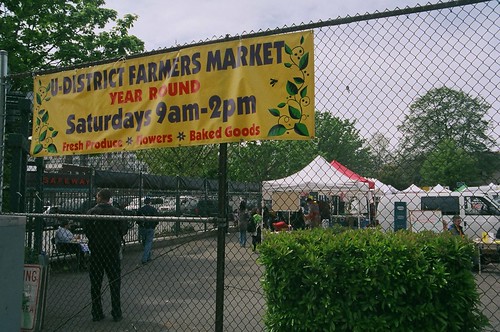
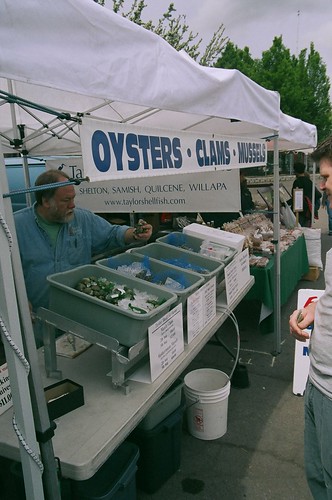
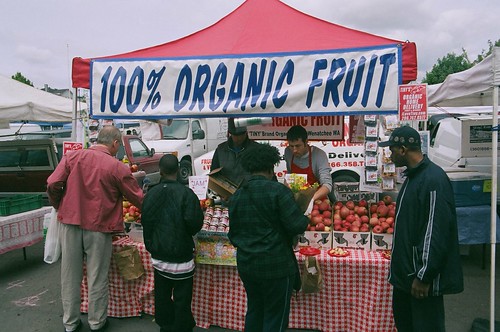
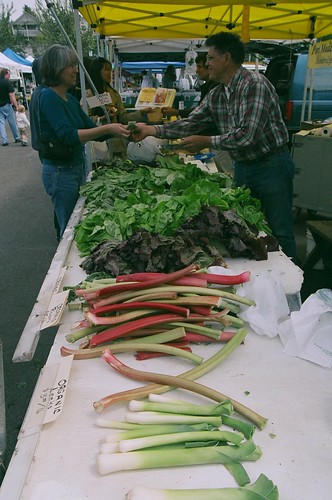 So what is my suggestion for you this week? Buy local produce. Not only will it probably reduce your carbon footprint, you will support diverse local agriculture, your food will be fresher, you will interact with more people, you'll have greater access to organic food, and if you consistently stick to local crop schedules, your diet will be more diverse. The other week, I took some photos of the University District farmers' market. For more, visit my flickr photo set.
Yesterday my wife and I stocked up on fruits, vegetables and kettle corn from the Lake Forest Park farmers' market. It is located in a shopping center adjacent to the Burke-Gilman bike trail, so we were able to pick up our produce without even firing up the horseless carriage. If you are in Seattle or Puget Sound, there are several markets to choose from. Find the closest one here. Some of the farmers will deliver produce weekly to you. One local company might even be advertised in the panel at right. Click on it to learn about them (and to give me a quarter!)
 The things about farmers' markets that I used to worry about was cost and spoilage. It is true that you will have to eat fresh fruits from a market sooner than chain-store bought items, but my experience is that they taste a lot better, and you can prolong their shelf life by storing them in the fridge. The veggies - greens and roots - last just as long. I was pleasantly surprised that the farmers markets sometimes SAVE you money! Here is a price comparison of what we bought with our cheapest grocery store:
- $3 of raspberries at the market = $6 at Safeway
- $13 flat of strawberries = $8.50 at Safeway
- $2 of squash = $3.75 at Safeway
- $4 kettle corn at market = unavailable at Safeway
- $1 baby Walla Walla onions = $1 adult onions at Safeway
- $2 baby bok choy = $2 at Safeway
- $3 purple, red and gold potatoes = $4 for gold at Safeway
We might get a third of our produce from local farmers' markets in the summer. In a temperate climate of Seattle, the only excuse for not buying local year round is convenience. Sometimes the only time I have to shop for groceries is between 9 and 11 PM!
There you have it: Eating local is one more way to reduce your carbon footprint. This method seems to have a number of other benefits, too!


